Friday, 25 September 2015

Bulls Head, Cosby, Leicestershire

The south Leicestershire village of Cosby was little more than half an hours walk for me when I lived in nearby Littlethorpe. At that time there were three decent pubs in the village centre, the Blacksmiths Arms, Huntsman, and Bulls Head, and I made the walk to Cosby quite often as a result. Today the village is down to just one pub and the Working Mens Club.

Despite strong opposition from locals and villagers the Huntsman is now a Co-op store, and the Blacksmiths has been an Indian restaurant for several years now. The one remaining pub in the village, the Bulls Head, is an Everards Brewery house, and thankfully for those locals still interested in such things, a very good one at that.

Everards continue to support pubs like the Bulls Head where others (such as serial pub-closers Marston's, the previous owners of the Huntsman) show little or no such commitment. They also have a good track record when it comes to maintaining their pub estate, and even if the current 'vintage' makeovers, which are being rolled-out across the estate, might not be to everyone's taste (it works very well at the Bulls Head), their pubs remain attractive and inviting as a result.


Just as importantly in the context of this blog, Everards are also custodians of more traditional Skittle Alleys in the Leicestershire area than any other brewer or pubco. This part of South Leicestershire, close as it is to Everards Castle Acres brewery site, is one of the hotbeds of Long Alley Skittles play, with Everards pubs in Broughton Astley, Croft, Enderby, Huncote, Littlethorpe, and Whetstone all boasting good indoor skittle alleys.

The alley at the Bulls Head would probably have been a separate building at one time, though now accessed directly from a central corridor of the pub. I think this is why the throwing end of this, and other similar alleys, are laid with deep transverse lines around the foot hole or 'Mott' (below). Winter journeys from bar to skittle alley meant that players shoes would often be wet, and these grooves would have provided a non-slip surface as players launched themselves down the alley.


A modern conservatory at the rear of the pub houses the Skittles Table, set here with plastic 'Northamptonshire' style pins, but this is actually a Leicester Skittles Table. The Leicester variant of the game is very similar to the more common 'Northants' version, but uses thinner pins shaped like miniature Long Alley skittles. The cheeses are proportionately smaller and usually made from a very dense hardwood such as Laburnum or Lignum Vitae, though I've also seen plastic examples.

Tables like this are the norm in  and around Leicester city, but can also be found in an area broadly defined as South-West Leicestershire, as well as the Soar Valley area of North Leicestershire. This seems to coincide with those areas which have the strongest remaining Long Alley tradition, perhaps suggesting that this version arose as a Winter alternative to the alley game, somewhat independent of the similar Northamptonshire game.

To complete the picture of this excellent village local, Darts is very popular, as evidenced by the number of trophies littering the bar, including the impressive Ladies Knockout Cup shown below. The Bulls Head was also an early-adopter of the food franchise concept, with the popular Winley's Chinese Restaurant operating successfully from a separate room at the pub.

Saturday, 19 September 2015

Prince of Wales, Shrewsbury

How best to describe the Prince of Wales. The pubs own website suggests 'Hidden Gem', which seems entirely legitimate to me. It might even be described as Shrewsburys best kept pub secret, certainly it's a little off the beaten track, though we found it easily enough. Indeed the landlady of the B&B we were staying in seemed reticent recommending the Prince of Wales to us, something to do with it being her local!

It can be like that with a well-loved locals pub, the last thing the regulars want is an influx of tourists and part time pub-goers clogging up the normal, efficient day-to-day service. But as we know, pubs need all the trade they can get these days, so I have absolutely no qualms in recommending this very fine pub to you, and urge you to seek it out the next time you visit Shrewsbury. Local Shrewsbury folk need no such urging, they've already found it, they're just not saying!

The view from the lounge to the Patio and Bowling Green
From the outside the pub presents itself as a fairly typical wide-fronted community local of a type which came to prominence in the inter-war years. These so-called 'improved' pubs were designed to replace some of the more 'earthy' Victorian and earlier boozers, and appeal to a wider range of tastes and social backgrounds. A feature of many was the inclusion of recreational facilities not primarily associated with drinking, and this period marked the beginnings of the dedicated beer garden proper. The wide frontage of the Prince of Wales gives a clue to the pubs star attraction. Not a beer garden but a full-size Crown Green Bowling Green which sees very regular use throughout the summer months.

If you've yet to witness a Crown Green Bowls match in progress this is probably the ideal place to see what all the fuss and noise is about (it's a far noisier game than its Flat Green relative). A raised patio overlooks the green, and there's plenty of 'stadium' style seating bordering the green for spectators (some rescued from the old Shrewsbury Town Football Club ground). It really is the perfect accompaniment to a cool pint on a warm summer evening.


Inside and to the left of the entrance is the public bar (above), home to the Darts Board and several raised-edge games tables suitable for the rattle and click of league Domino play. Dominoes is still very popular in Shropshire and the local Shrewsbury Domino League seems to be well supported in the more traditional pubs of the town.

A central bar serves both the bar and lounge. Originally a Border Breweries pub, the Prince of Wales is now free of tie, and when we visited the beer range included excellent local ales from Salopian and Three Tuns breweries. The pub is the current (2015) Shrewsbury CAMRA Pub of the Year.


The sharpening stone, grooves worn deep from many years of restoring a sharp point to Darts.

Friday, 11 September 2015

The Herdsman, Hereford

Occupying a substantial corner plot on the outside-edge of Herefords busy ring road, the solid three-story 'block' of The Herdsman is hard to miss. Yet when I popped in for a pint on a hot summer day last year, not only was it my first visit, in all honesty it was the first time I'd even noticed this imposing, unmissable pub!

Certainly it had been a few years since my last trip to Hereford, but I'm no stranger to the attractions of the town, particularly those centred around the county's most famous export, fine traditional cider. The fact is, the Herdsman simply wouldn't have registered on my finely-tuned beer and cider radar in those days. Little has changed in this regard, and on the occasion of this visit I made do with a perfectly acceptable Guinness, though I'm reliably informed that a real ale has been introduced since then.


The real attraction of the Herdsman may not be obvious from a casual inspection of the bar, although the neat row of polished trophies lining the bar-back should give a clue. This is a pub for the games and sport enthusiast first and foremost, beer merely the lubricant to competition, not the main attraction. This is no 'Sports Bar' though. The Herdsman is home to the more traditional, though no less competitive pastimes of traditional pub gaming, and in this regard the pub is truly unmissable.

It's in the hallway to the rear of the bar that you'll find confirmation of this on the all-important noticeboard, crammed as it is with fixture lists for the many teams which play out of the pub. Cribbage, Darts, Skittles, and the local game of Quoits all feature. There can barely be a night when there isn't something going on at the Herdsman, live televised sport filling the gaps along with numerous functions and charitable fund raising events. Even the local Chess Club meet at the Herdsman.

This is a true community local of a type which is getting scarcer by the day. I found the Herdsman a friendly and welcoming pub too, and I'll certainly be returning for a pint the next time I'm in town.


There are two of the traditionally painted concrete Quoits Boards at the Herdsman, one in the small Pool room (below), the other in the large function room at the rear of the pub (shown above). All Hereford Quoits Boards sit on specially fabricated steel frames similar to that shown above, netted to prevent too many wayward Quoits landing on the floor. I use my Quoits Board without one of these, and know how much of a pain it is having to retrieve the floppy rubber Quoits from wherever they might have landed, or subsequently rolled off to. I really must get one myself! The rubber Quoits used in this game are difficult to source and surprisingly expensive to replace, so not usually on show with the boards. A set should be available from the bar for a casual game outside of league nights though.

There are Mens and Ladies Quoits Leagues in Hereford, and the Herdsman field teams in both. In fact the Herdsman seems to be the HQ for league Quoits play in the city.


The function room at the rear of the pub is also equipped with several Darts Boards for play in the various local leagues, and two well-used Skittle Alleys. The Herdsman is perhaps unique in being the only pub in the town with three good alleys, a further one being located upstairs, though some Hereford club venues have multiple alleys too.

The Hereford & District Invitation Skittles League was formed in 1902, and is still going strong in the area with 66 teams competing in 7 leagues. Four teams share the alleys at the Herdsman, and the best night to catch a game is probably Friday.

Tuesday, 8 September 2015

Pub Games and Brewery Advertising

These relatively cheap, mass-produced Dominoes probably date from before the mergers of the 1960's which would eventually create the mighty Bass brewing empire. M&B itself was created from the merger of two Birmingham breweries in 1898, giving Mitchells & Butlers a huge presence throughout the Midlands. A presence which consisted mainly of classic urban locals from the pre-war era, and newer suburban and estate pubs built to serve the rapidly expanding conurbation of the West Midlands. Just the kind of busy community locals where the bar room staples of Darts, Cards, and Dominoes would have been ubiquitous. M&B still exist, though as a non-brewing pubco.
This 'St George Series' Cribbage Board probably dates from the early 1970's. Like the Dominoes shown above, this design was mass-produced for many regional breweries around this time, with only the stamped and painted brewery logo altering. Following the creation of Allied Breweries in the early 1960's, Ansells Brewery, which would have been M&B's main rival in the Birmingham area at that time, eventually ceased brewing. Their highly regarded Bitter and Mild were quite common in my home area of Leicestershire owing to a previous acquisition of the Leicester Brewing & Malting Co, but following their transfer to the Ind Coope plant in Burton, Ansells beers have now all-but disappeared.
Ind Coope Double Diamond was one of a handful of bland, over-processed kegged beers that would inspire the creation of the Campaign for the Revitalisation of Ale (later 'Real Ale') in 1971. As a brand Double Diamond goes back much further than the 60's, but I'm confident that these Darts flights were produced to advertise the 'classic' 60's keg version at a time when Ind Coope had pretentions of developing Double Diamond as a national brand. The Darts shown here are by Unicorn, originally retailed by R J Ward of Great Yarmouth, and quite chunky by today's standards.

Still in the Midlands, Offilers' were Derbys premier brewers until bought up and closed by Charringtons in the 60's. Judging by the attire of the lady perched on a bar stool, these cards date from the 1950's, and were made for the brewery by John Waddington Ltd, the worlds largest manufacturer of playing cards at the time.
The famous strapline 'Guinness is Good For You' was one based entirely on clever marketing rather than any genuine health benefits, yet even today many people believe the drink is especially rich in iron. The days of recommending a bottle of Guinness a day for pregnant women are of course long gone, but the Dublin brewers are one of the few still marketing a branded set of playing cards (below) drawing on the brewers rich archive of advertising images, albeit a non-standard size deck principally for the tourist trade. The Marston's brewery set shown below are also modern.

These Poker Dice could date from before the closure of Flowers Stratford-on-Avon brewery in 1968, though they're just as likely to be advertising the Cheltenham brewed beer prior to that brewery's closure in 1998.

Monday, 31 August 2015

Albion Brewery Tap, Northampton

The renaissance of beer and brewing in the UK has brought with it a welcome revival of many 'gone but not forgotten' ales from the past. For the most part these are simply recreations from original brewhouse recipes, sometimes perfected with the help of former brewers, often with the help of an enthusiastic tasting panel of old-timers who can still remember how these beers used to taste.

The chance to recreate a beer in its original home is more often than not an impossible dream. Many of the breweries which were closed in the latter half of the 20th century have now been demolished to make way for commercial or municipal development, and where brewery buildings do remain, they have often been irrevocably converted to residential or retail use.

Phipps NBC of Northampton effectively ceased as a brewing concern in the early 70's following the takeover of the business by Watney Mann of London. Both the Phipps and Northampton Brewery Co premises were soon demolished, the sites redeveloped to include the huge Carlsberg Brewery which continues to dominate the south of the town to this day. So when the current team hatched plans to revive the Phipps name in Northampton, a return to the original brewing site was simply not on the cards.

Following several years contract brewing Phipps and NBC ales at a brewery in Rutland, a chance to return production to Northampton presented itself when the former Albion Brewery on Kingswell Street became available. The Albion Brewery is barely a stones-throw from the original site of brewing, and shares the same water supply which helped give their beers such a distinctive local taste. This was as close to an authentic revival of the Phipps NBC brewing heritage as anyone could have reasonably hoped for. Brewing re-commenced in Northampton in 2014, and Phipps NBC beers are now widely available throughout the county and beyond.


At the peak of their success following merger, Phipps and the Northampton Brewing Co had well over 1,000 pubs, as evidenced by the fact their logos (and the latter-day Mann's livery) can still be found on pubs throughout the county. It has always been the intention to open a pub at the Albion Brewery site, and much reclaimed Phipps and NBC memorabilia has been incorporated into the Tap at the front of the brewhouse. It's a fabulous achievement, and regarded by many as one of the most successful revivals of our British brewing heritage. You can learn much more about the history and current plans for Phipps NBC on their excellent website: http://www.phipps-nbc.co.uk/


Don't be confused by the image above, this view into the Albion Brewery Tap from the entrance lobby has been flipped to 'correct' the writing. Through the windows can be seen the Bar Billiards Table and Northamptonshire Skittles Table. At one point, there was some uncertainty as to whether there would be space in the bar for these classic bar-room games, but I'm pleased to say that tradition has won out again, and both games are proving to be popular with customers.


The small orange label on the left-hand leg identifies this Skittles Table as having been made by G J Pepper of Wellingborough. Pepper's tables have straighter side cushions than the more common W T Black & Son models, and can usually be identified by their upright square netted 'hood' as opposed to the sloping style of a Blacks table. They are also considered by many to be the best quality tables.

Saturday, 22 August 2015

White Lion, Bridgnorth, Shropshire

If like me, you choose to stay in Bridgnorth Low Town, you'll certainly want to explore the adjacent higher version, if only because there's a fair bit more up there than below. There are a number of different routes up the hill, some a good deal easier to traverse than others, but all interesting in their own way. I'd recommend the steep but attractive Cartway, resembling a vintage Hovis advert in places, which just happens to pass recently re-opened specialist beer pub the Black Boy, which I'd also recommend. Or the longer though no less attractive Bridgnorth Park route, which passes the famous Severn Valley Railway terminus with its own highly regarded beer emporium the Railwayman's Arms.

Of course no trip to Bridgnorth would be complete without a ride up the Cliff Railway, a fully working relic of a bygone age, and a very reasonably priced alternative to the many admittedly healthier alternatives.


In a sense, all routes lead to the excellent White Lion, located as it is at the southern end of the High Street, and a mere stones-throw from the Cliff Railway top 'station'. Over the course of a long weekend, I managed to poke my nose into almost all of Bridgnorth's pubs, and I can safely say this was one of the very best, if not 'the' best in the town. In fact I almost had an Orwellian 'Moon Under Water' moment when I walked into the bar, such was the friendly welcome and all-round excellence of the pub.


The White Lion is a traditional two-roomer, immaculately maintained throughout, and with the sweetest little beer garden at the rear for sunny Shropshire days and Summer evenings. A pub that just feels 'right' as soon as you step over the threshold. A well judged range of beers, including at least one from the pubs own Hop & Stagger Brewery, and bar snacks appropriate to the business of social drinking rather than a full sit-down meal. There are games too, the rear bar featuring a red-baize'd Bar Billiards Table which is free to play on Mondays.

Propped up on a window ledge you'll also find a good old Shove Ha'penny, on loan to the pub by a regular. In my view Shove Ha'penny is one of the finest accompaniment to social drinking there is, and the cause of many afternoons that got away from me! Not a problem at the White Lion though, there is after all the ever-reliable Cliff Railway to take you home.


Sunday, 16 August 2015

Top House, Thurmaston, Leicester


Until the recent reopening of the Top House, pub-going in the north Leicestershire village of Thurmaston had appeared to be in freefall, such were the number of pub closures in recent years. From a choice of around half a dozen pubs in the 80's/90's, the village was down to just one survivor on the main street, former Shipstones Brewery pub the Harrow, with the Prince of Wales, Generous Britain, Manor, Lonsdale, and White Hart, all closed for good within the last two decades. Only the Everards owned Willow on the outskirts of the village offered a choice in the immediate area. The closure of the Top House was particularly sad given that it was such a busy community pub in its day, and a very fine example of a Victorian corner local.

The demise of so many of Thurmaston's pubs is perhaps hard to explain given its largely residential make-up, though being effectively isolated from much of the populace by the busy A607 probably doesn't help. One factor that will almost certainly have affected the viability of some of Thurmastons pubs is the number of thriving social clubs in the village. I've noticed on several occasions that when a community pub like the Top House closes, trade doesn't always gravitate, as you might expect, to the nearest alternative pub venue. It's often the local social, trades, and political clubs, with their cheaper drinks and strong social/gaming traditions which benefit most from the displaced custom.

The Top House has thankfully now reopened, and done so in very fine style. In fact it's a delight to the eye for pub enthusiasts like myself, as I hope you can see from the images reproduced here. I do hope it has a brighter future than many of its near neighbours, pubs like the Top House are precious survivors, and have features which when they've gone, they're gone forever.


This former Shipstones house was originally named the Unicorn & Star, but for many years was known locally as the Top House, presumably due to its location at the top of the main street through the village. It assumed this name officially in 2003 following a refurbishment.

Both the Harrow and the Top House were always firm favourites with local CAMRA members back in the day when folk seemed to appreciate traditional boozers like this a great deal more than its predominantly beer-obsessed membership do now! The pub was much as it is now, a two-room locals pub, albeit furnished in a more basic and functional style befitting the time.


CAMRA's late 70's pub guide to the county describes the Unicorn & Star as being a '...popular darting and dominoes pub', and the sizeable public bar to the left of the entrance certainly lends itself well to this kind of games play. I don't know whether the Domino players have returned yet, pub closures, however short, result in disruption to league play that can take a season or two to resolve, but Darts and Pool are played in local leagues.

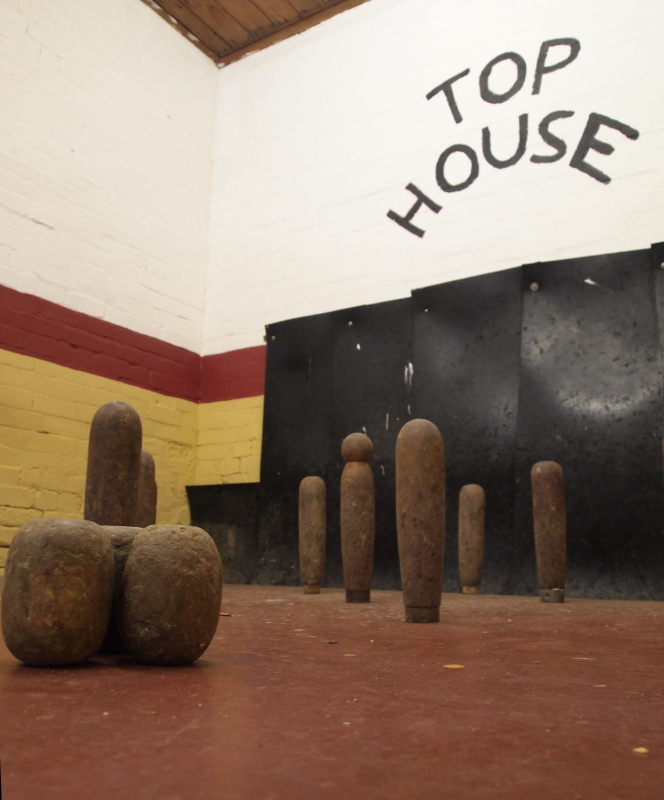
To the rear of the pub is the Skittle Alley, where Long Alley and the unique Leicester version of Table Skittles is played. The Top House was an active participant in the Syston & District League right up until the recent temporary closure, and now field a team in the second division.


Cheeses for Long Alley, and a box of pins for Leicester Table Skittles below the scoreboard