Showing posts with label Nine Men's Morris. Show all posts

Monday, 3 May 2021

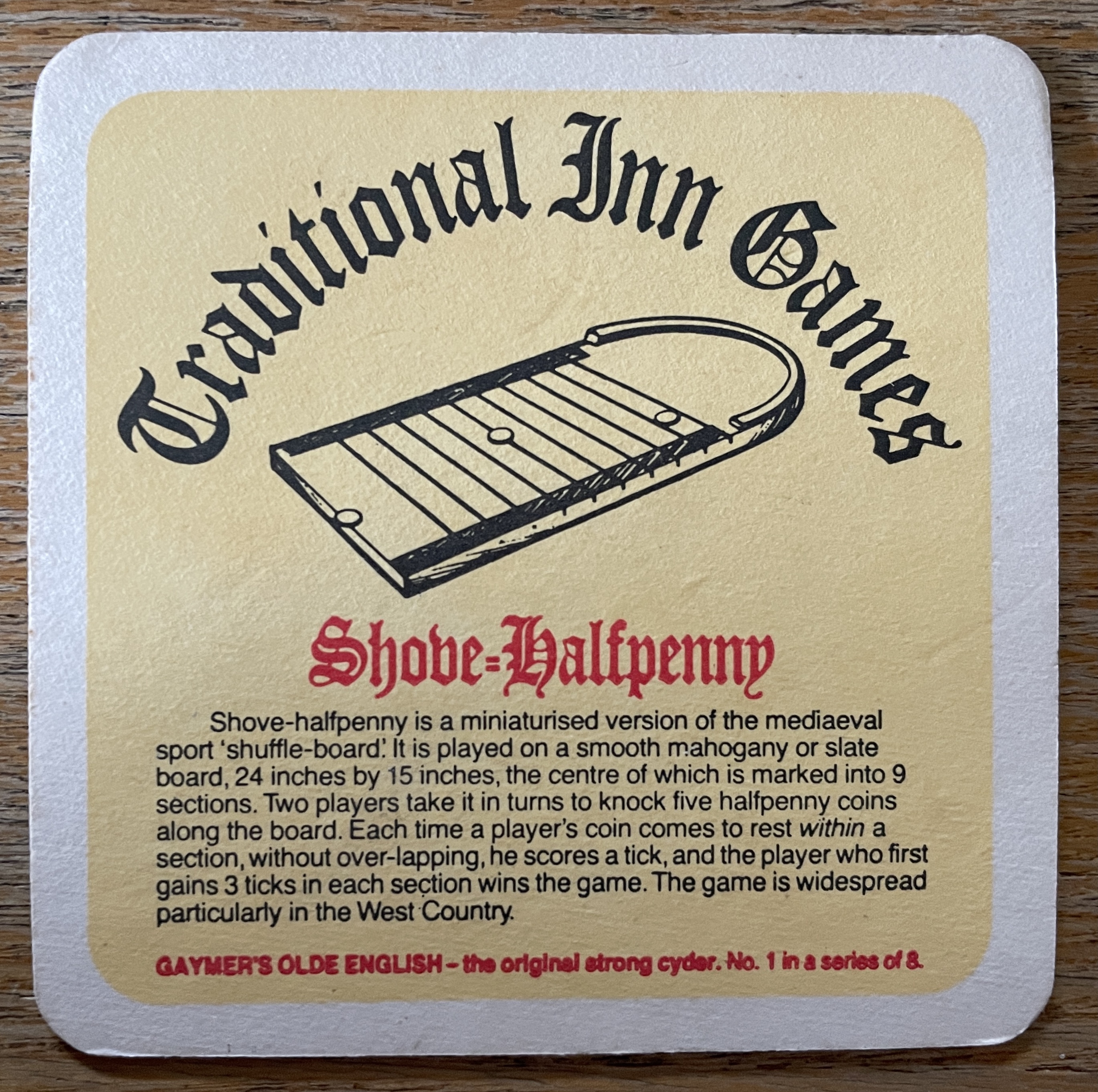
Traditional Inn Games - The Gaymer's Cyder Beermat Collection

Pub gaming ephemera and equipment has long been a medium for drinks and tobacco companies to advertise their wares. Playing Cards, Dominoes, Darts Flights and Scoreboards were all commonly appended with Brewery names and Tobacco brands, and along with league sponsorship there are few areas of the pub games tradition that would have escaped the marketing departments attention.

In truth, I doubt whether this kind of advertising was intended to sway drinkers and smokers one way or the other to any great degree, all pubs being very firmly tied to their respective breweries back then. I'd imagine that then, as now, drinker and smoker preference was based largely on personal taste, price, and choice of pub rather than the hard sell of an attractively branded Cribbage Board. These items were more about brand loyalty, cheap or free tokens available to customers as part of the all-important 'sales rep - licensee' relationship.

So customers got to play their favoured games at the pub without the added expense of having to supply their own equipment, and the drinks and tobacco industry obviously saw the value of rewarding valued customers with relatively inexpensive branded tokens of their appreciation, thereby cementing the relationship between brand and customer. The legacy of all this of course, is a healthy interest from enthusiasts of all things Brewery and Tobacco related, indeed some of these everyday items are worth quite a bit to collectors nowadays.

Occasionally, as shown here, the tables are turned and a drinks company enlists the help of traditional pub games to sell their products, in this case via the time-honoured method of the Beer Mat. Never ones to miss a trick, marketing departments know the value of a well placed 'info-mat', branded on one side, concisely informative on the reverse, and a last-resort bit of reading material in times of idle boredom at the pub. Make them a numbered set and you're guaranteed to want to read (or indeed collect) them all.


This set was produced by Gaymer's, probably around the time the brand was in the hands of Mathew Clarke in the 1990's. Olde English Cyder was a huge cider brand back then, the unique 'Costrel Barrel' keg fonts and false handpumps seemed to be on the bar counters of just about every pub, presumably the result of a massive marketing push, of which these mats would have played their part.

Eight in number, these beer mats feature Traditional Inn Games that would have been quite rare, or at the very least in serious decline even then. The descriptions are accurate enough though, such that I have to wonder who's work the marketeers drew more heavily on, Arthur Taylor or Timothy Finn!

Olde English Skittles (No.6) takes preference over more common variants of the game, presumably because of the 'Olde English' prefix fitted better with the cider brand being advertised. To say that 'The game still flourishes in certain parts of London' is somewhat fanciful. I think at this time there may have been just two, maybe three venues for the game, of which only one pub alley survives today (where it does indeed flourish).

I can't in all honesty say I've ever seen Nine Mens Morris (No.5) being played in the pub, though I have seen examples of the games unique board on occasion. The same cannot be said for Dominoes (No.4) of course, which is still one of the most popular games found in the pub, albeit that the mat refers to the 'Block' game rather than the more 'pubby' Fives & Threes version played competitively in pub and club leagues.

Dobbers (No.7) is a name rarely used these days for the game of Indoor Quoits depicted on this mat, and sadly even then it was probably almost extinct as a game in the Vale Of Evesham when these were in circulation. The game clings on in just a handful of reasonably well-supported leagues, located along the Welsh Borders area.

Shove Halfpenny (No.1), or Shove Ha'penny, is indeed widespread in that there are still many boards for the game in existence, though sadly not so many located at the pub these days. Competitive league play can still be found in the West Country, Wales, and in its Pushpenny variant, Lincolnshire and Sussex.

As stated on the mat, Quoits (No.3) remains relatively popular in certain parts of Northern England, though its status in East Anglia is now less certain. At one time regarded as a national sport to rival Football, the game remains a fantastic spectacle for the casual spectator during a Summer evenings play.

The final two mats are real curiosities. Tossing the Penny (No.8) still exists in a handful of pubs in Anglia, with one outlier at a pub in Rutland. A real glimpse of rural pub life, an unsophisticated game for farmers and villagers that's literally part of the furniture in those few pubs where the game survives. Similarly, Ringing The Bull (No.2) was a pub pastime created to while-away an afternoon or evenings drinking. Little more than a tethered copper Bull Ring and a hook, it's hard to imagine how the brewery and tobacco marketeers would have enlisted these two games to their cause.

Sunday, 27 April 2014

A Compendium of Pubs Games Images - Pt. 20


This interesting stone frieze remains above the main entrance, but Ye Olde Bowling Green Hotel in Chester is long gone. The historic building remains though, and is now home to the St Werburgh Parish Centre, a fully licensed members club which offers Darts, Pool, and Snooker, as well as the local speciality of Bagatelle. The original Bowling Green was threatened with destruction following the sale of land at the rear of the building for development. But after several years of neglect and legal wrangles the green has now been lovingly restored by the club, and Bowling resumed in 2008.


This interesting piece of breweriana has recently been added to my growing list of 'mystery gaming objects'. Essentially a plain Mahogany box overlaid with a silvered brass or copper plate advertising Bass in Bottle. The perplexing aspect of this attractive little box, is the two sets of drilled holes in the metal plate, 16 in total, arranged in a similar pattern to a cribbage board.

Despite engaging the opinion of experts in the fields of pub games and breweriana, the purpose of this box, and the identity of the game associated with it remains a mystery. The main issue being that the number of holes on the 'scoring board' don't correspond to any game anyone can currently think of. I also have my suspicions that this object may have been locally crafted rather than manufactured specifically for the Bass Brewery as an advertising item. Certainly the metal plate appears to be 'correct', perhaps a re-fashioned plaque which would have originally been mounted outside a hotel or smart club, but even this is proving difficult to identify. If anyone reading this has seen something similar, or has any idea what game this box might have been used to score, I would be delighted to hear their thoughts.


The small Cambridgeshire market town of Whittlesey seems to me to have a slightly above average number of pubs for its size, many of which are traditional drinking establishments with a strong local following. There have obviously been closures in recent years, including the impressive George Hotel which has only recently re-opened as a Wetherspoon, but those that remain seem reasonably well supported.

The Bricklayers Arms on Station Road is currently closed and showing obvious signs of neglect, but during the annual Straw Bear Festival in 2014 the pub was temporarily re-opened for the crowds and visiting dancers. The pub has certainly seen better days, but vestiges of its former life as a valued local remain, including the Darts Board (above), and a trophy cabinet in the small snug to the right of the entrance. Pride of place amongst the handful of trophies is a large polished-out shield for the Whittlesey Town Domino League, a game still played in pubs and clubs throughout the town at league level. It's perhaps not surprising that this shield is now lacking it's attractive silvery shine, given that the Challenge Shield was first played for in 1926.


An enamelled trophy badge from the Taunton Brewers Skittles League. This league is still active in and around the Somerset town, though which Taunton brewers were the original sponsors of the league is not clear.

This Nine Men's Morris (or Welcome as it's known here) has at first glance the authentic appearance of a vintage wooden board, but in fact it's a cheaper moulded plastic item of a type commonly produced by manufacturers like Invicta of Leicester. It's another good example of a brewery branded game, this one featuring the famous Bass Charrington 'Toby' logo which dates it to the 1970's. In fact an example of this game appears in Timothy Finn's 1975 book 'Pub Games of England'. In all honesty, it looks like it's never been played, perhaps not surprising given how few people would have known how to play Nine Men's Morris at the time.

Tuesday, 12 March 2013

Nine Men's Morris

My own Nine Men's Morris Board, pictured at The Castle Inn, Castle Bytham, Lincolnshire, a cosy and welcoming village pub where Pool, Darts, and Dominoes are available to play.

Even before we explore a little of the history of Nine Men's Morris (also known as Merrels), it's simplicity of form clearly marks it out as a game of great age. Believed to date back to Roman times at least, Merrels seems to have been a game of common folk, often played on a simple scratched playing surface (see below) using pebbles or perhaps cereal grains as counters.

A simpler form of the game is known as Three Men's Morris, examples of which have been found carved or scratched onto surfaces dating from pre-Christian times. Three Men's Morris is played on a smaller 'board' using only three counters apiece, but resembles the nine counter version in that the object of both games is to arrange your counters into a straight line of three, called a Mill, in order to capture your opponents counters. The rules are simplicity itself, and yet these are games of real skill and strategy. An online version of the game can be played on the Tyne and Wear Archives & Museums website: Nine Men's Morris).

But can Nine Men's Morris really be considered a pub game? Clearly the game has been played in pubs for very many years, and yet to my mind it doesn't seem to have any particular affinity to the pub, any more so than the Churches and Cathedrals where so many Morris 'boards' have been found scratched into pews and benches. It's a matter of semantics I guess. Does the playing of a game in a pub naturally confer on it the status of a Pub Game? Clearly all pub games originated as games which were then adopted by pub goers, and whilst Nine Men's Morris is rarely seen these days, at one time it was presumably a very popular game in the tap room. Whatever, the game of Nine Men's Morris is a very good way to spend time with a pint and a friend, and in this regard it is an ideal candidate for pub play.

The stone benches in the porch of Honington Church in Lincolnshire are covered in scratched graffiti, including many of the crossed squares which would have been used for the game of Three Men's Morris. Note the indentations at the intersections where the counters would have been placed.

Heavily worn Three Men's Morris squares scratched onto the porch benches at Market Deeping Church in Lincolnshire.


This large solid wood Nine Men's Morris Board is one of several traditional games available at the wonderful Queens Head, Newton, in Cambridgeshire. The game was apparently known as Murrels in Cambridgeshire, and Meg Merryleys in Lincolnshire.