Showing posts with label Pitch Penny. Show all posts

Monday, 3 May 2021

Traditional Inn Games - The Gaymer's Cyder Beermat Collection

Pub gaming ephemera and equipment has long been a medium for drinks and tobacco companies to advertise their wares. Playing Cards, Dominoes, Darts Flights and Scoreboards were all commonly appended with Brewery names and Tobacco brands, and along with league sponsorship there are few areas of the pub games tradition that would have escaped the marketing departments attention.

In truth, I doubt whether this kind of advertising was intended to sway drinkers and smokers one way or the other to any great degree, all pubs being very firmly tied to their respective breweries back then. I'd imagine that then, as now, drinker and smoker preference was based largely on personal taste, price, and choice of pub rather than the hard sell of an attractively branded Cribbage Board. These items were more about brand loyalty, cheap or free tokens available to customers as part of the all-important 'sales rep - licensee' relationship.

So customers got to play their favoured games at the pub without the added expense of having to supply their own equipment, and the drinks and tobacco industry obviously saw the value of rewarding valued customers with relatively inexpensive branded tokens of their appreciation, thereby cementing the relationship between brand and customer. The legacy of all this of course, is a healthy interest from enthusiasts of all things Brewery and Tobacco related, indeed some of these everyday items are worth quite a bit to collectors nowadays.

Occasionally, as shown here, the tables are turned and a drinks company enlists the help of traditional pub games to sell their products, in this case via the time-honoured method of the Beer Mat. Never ones to miss a trick, marketing departments know the value of a well placed 'info-mat', branded on one side, concisely informative on the reverse, and a last-resort bit of reading material in times of idle boredom at the pub. Make them a numbered set and you're guaranteed to want to read (or indeed collect) them all.


This set was produced by Gaymer's, probably around the time the brand was in the hands of Mathew Clarke in the 1990's. Olde English Cyder was a huge cider brand back then, the unique 'Costrel Barrel' keg fonts and false handpumps seemed to be on the bar counters of just about every pub, presumably the result of a massive marketing push, of which these mats would have played their part.

Eight in number, these beer mats feature Traditional Inn Games that would have been quite rare, or at the very least in serious decline even then. The descriptions are accurate enough though, such that I have to wonder who's work the marketeers drew more heavily on, Arthur Taylor or Timothy Finn!

Olde English Skittles (No.6) takes preference over more common variants of the game, presumably because of the 'Olde English' prefix fitted better with the cider brand being advertised. To say that 'The game still flourishes in certain parts of London' is somewhat fanciful. I think at this time there may have been just two, maybe three venues for the game, of which only one pub alley survives today (where it does indeed flourish).

I can't in all honesty say I've ever seen Nine Mens Morris (No.5) being played in the pub, though I have seen examples of the games unique board on occasion. The same cannot be said for Dominoes (No.4) of course, which is still one of the most popular games found in the pub, albeit that the mat refers to the 'Block' game rather than the more 'pubby' Fives & Threes version played competitively in pub and club leagues.

Dobbers (No.7) is a name rarely used these days for the game of Indoor Quoits depicted on this mat, and sadly even then it was probably almost extinct as a game in the Vale Of Evesham when these were in circulation. The game clings on in just a handful of reasonably well-supported leagues, located along the Welsh Borders area.

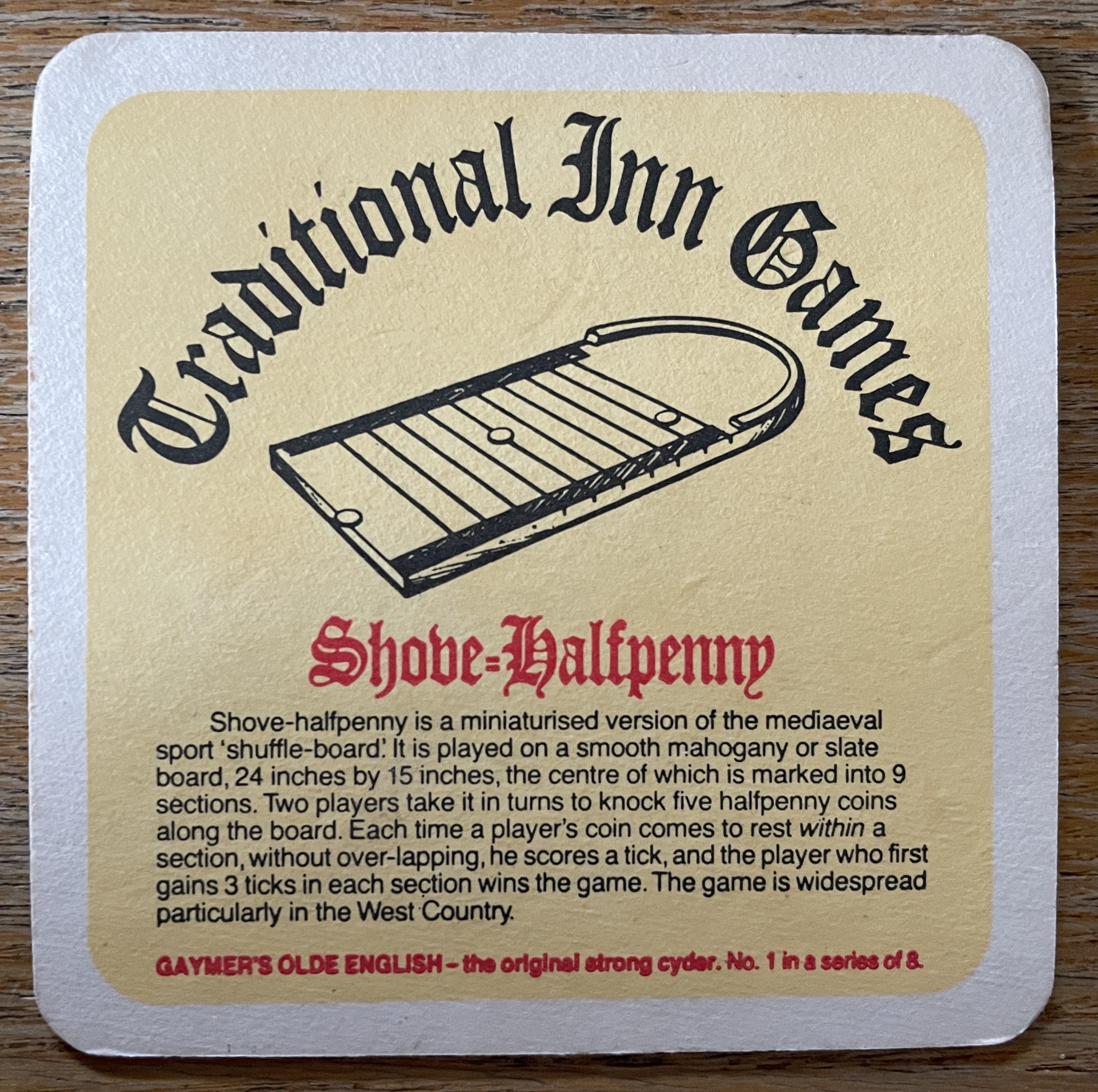
Shove Halfpenny (No.1), or Shove Ha'penny, is indeed widespread in that there are still many boards for the game in existence, though sadly not so many located at the pub these days. Competitive league play can still be found in the West Country, Wales, and in its Pushpenny variant, Lincolnshire and Sussex.

As stated on the mat, Quoits (No.3) remains relatively popular in certain parts of Northern England, though its status in East Anglia is now less certain. At one time regarded as a national sport to rival Football, the game remains a fantastic spectacle for the casual spectator during a Summer evenings play.

The final two mats are real curiosities. Tossing the Penny (No.8) still exists in a handful of pubs in Anglia, with one outlier at a pub in Rutland. A real glimpse of rural pub life, an unsophisticated game for farmers and villagers that's literally part of the furniture in those few pubs where the game survives. Similarly, Ringing The Bull (No.2) was a pub pastime created to while-away an afternoon or evenings drinking. Little more than a tethered copper Bull Ring and a hook, it's hard to imagine how the brewery and tobacco marketeers would have enlisted these two games to their cause.

Wednesday, 11 March 2015

Pitch Penny

George Green displays the now lost Pitch Penny bench in the bar of the Plough, Little Downham, Cambridgeshire. This image is reproduced with the kind permission of John Clarke of the Little Downham Community Archive
Traditional pub games are found throughout the British Isles. Some such as Darts, Dominoes, and Pool could rightly be considered to be national pastimes, albeit played to a bewildering array of different rules and conventions. Others, such as Aunt Sally, Pushpenny, and the numerous variations on the theme of Skittles are more regional, sometimes even local to a particular town or county. The more local a game is, the more interesting it is in many ways.  The bar-room staple of a Darts Board is unlikely to stir much interest from visitors to a pub, whereas a Sussex Toad in the Hole or a game of Aunt Sally in progress certainly would!

A region or local area which can justifiably claim to have its own unique pub gaming tradition, is something the locals should be proud of in my view. Yet so few pub-goers seem to be even aware of these unique regional specialities these days. Often the more unusual local games are kept out of sight, only really known to the locals, and sometimes taken for granted to a degree bordering on neglect. Rarity like this can certainly be interesting to the enthusiast like myself, but sadly it can often contribute to the decline, even the eventual death of a pub game.

The Pitch Penny Settle at the Coach & Horses, Tilney St Lawrence near Kings Lynn
The Eastern counties of England, and particularly those which make up the Anglian region, can lay claim to some truly rare and local pub games. Sadly this includes many which have either disappeared from pubs, such as the Suffolk version of Indoor Quoits, Norfolk Table Skittles, and Four Pin Skittles; or cling on as rare curiosities such as Caves, the Norfolk Twister, and the game featured in this blog post, Pitch Penny.

Pitch Penny is such a simple, home-spun game that it has never been 'manufactured' to my knowledge, and has the feel of a genuine rural curiosity. A farming pastime from an age when a visit to the pub was a much-needed release from the day-to-day agricultural labour. A real piece of rural social history in fact.

It's perhaps hard for us to understand how important the local pub would have been in the days before cars became affordable, and popular entertainment was beamed directly into our homes. In the relatively isolated rural locations of the Eastern counties, gaming at the pub would have been one of the few affordable social pleasures available to a man, a trip to the town or city largely restricted to market days and the pursuit of rural commerce. It's within this context that a game which simply involved tossing coins or other discs into a hole bored out of a bench or settle became popular, perhaps even common in village pubs throughout the Eastern counties.


The Pitch Penny game as it's usually found at the Coach & Horses
Very few of these old games survive now, but a good example can be found at the Coach & Horses, Tilney St Lawrence in Norfolk. The pub stands isolated on what would once have been a busy road into nearby Kings Lynn, a farmers bar and latter-day roadhouse largely bypassed by both now. The interior features a pair of very old high-backed settles which help give the otherwise modernised bar a cosy and genuinely historic feel. It's on the now cushion-covered seat of one of these settles that the rare Pitch Penny game can be found. The game is sadly not in use at the present time owing to a lack of suitable coins and the upholstery on the bench, but dare I say if you brought your own coins (see below), the licensee might be persuaded to bring it back into use during quieter times!

When stripped of its seat cushions, the Pitch Penny game is revealed in all its play-worn simplicity. A semi-circular hole at the rear of the seat surrounded by a battered protective layer of lead sheeting. The seat itself has been altered or repaired at some point, incorporating a separate piece of timber, presumably following many years of aerial bombardment from heavy coinage. Below is a rudimentary drawer to catch the 'holed' coins during a game, a feature of all Pitch Penny benches it seems.

The game itself was not usually played on a points scoring basis, rather the aim was to be the first to 'hole' all of their coins either as a singles or team game. Coins used seems to vary, but the old (and increasingly expensive to obtain) 18th/19th century 'Cartwheel' pennies were often favoured, indeed discs of a similar size are still used in Sussex for the 'pitching' game of Toad in the Hole. The weight and size of these coins are ideal for games like this, landing with a solid 'thunk' on the surrounding lead rather than pinging off and disappearing in the nooks and crannies of the bar.


The Jackson Stops Inn at Stretton in Rutland represents one of the most westerly examples of a surviving Pitch Penny bench, and has already featured on this blog. Located in the cosy snug adjacent to the fire, and known locally as Nurdles, the game is still in occasional use including for an annual 'World Championship'.

The Pitch Penny Bench at the Golden Cross, Clee Hill, Shropshire. A game far from its original home, but a must-have part of the licensees extensive collection of traditional pub games 

Friday, 14 November 2014

Golden Cross - Clee Hill, Shropshire

Should you ever find yourself in the lovely Teme Valley area in search of a pint with a view, the Golden Cross at Clee Hill should fit the bill perfectly. I wouldn't particularly recommend the trip when snow is forecast though. The roads are steep and winding, particularly the one from Tenbury Wells that I chose to drive up, and I'd imagine the village can become somewhat isolated when the weather turns nasty.

The view from Clee Hill is certainly impressive, but if you like a good game with your pint, you may find it difficult to drag yourself away from the bar and take it all in. That's because the Golden Cross is home to one of the most impressive collections of traditional games your likely to find in a pub. Acquired by licensee and pub games enthusiast Aaron Jeffs over the course of several years, there's hardly a category of game which isn't represented at the pub.

The first item to meet your gaze on entering is a fine old Bar Billiards Table, covered when not in use and therefore in excellent playing condition. It's a John Bennett & Co table, a Billiard table manufacture which held a Royal and War Office warrant at one time, this table dating from around the 1950's judging by the London address on the name plate.


From my perspective, the most important gaming item at the Golden Cross is also one of the most humble in form. A simple, unpainted concrete Quoits Board sits solidly below one of several Darts Boards at the pub, again covered when not in use to prevent stray Darts Arrows damaging the surface. Quoits is of course the local game for the Shropshire/Herefordshire area, and league matches can be seen at the pub throughout the summer months, Darts and Pool taking precedence in the winter. Rubber Quoits and all the other paraphernalia of pub game play are available from the bar on request.

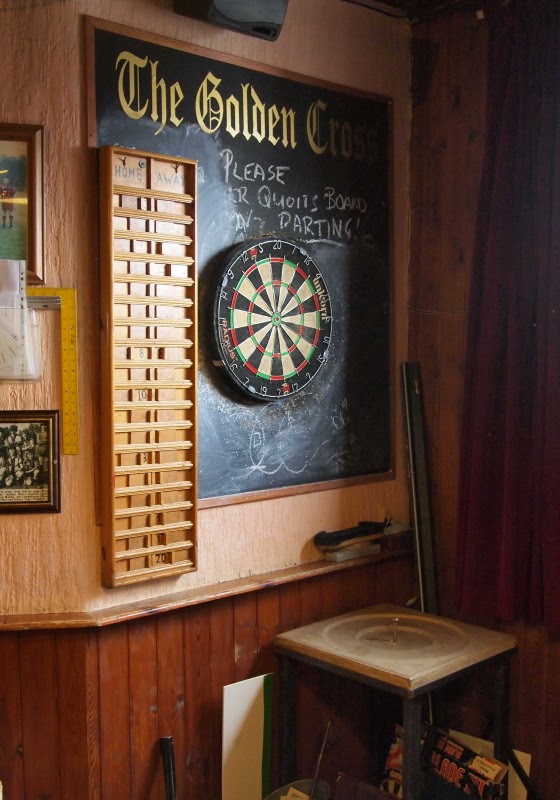
Note the unique handmade scoreboard to the left of the Darts Board. Outside of the Hereford Town League, where Quoits is a straightforward scoring game along similar lines to Darts, most leagues play a game where each team or player aims to accumulate specific scores, maybe from 1-12 or 1-15. Four Quoits are thrown and if for example 8 is scored, that panel on the board is claimed and becomes closed to your opponent. The board here goes up to 20, but given that this would require a full house of 'Pegs' (which score 5 points), perhaps the full board is reserved for 'expert' matches rather than regular weekly league play. Or maybe players in the Clee Hill League are far better than I give them credit!


Rare and unusual games are represented at the pub in the form of a fine Pitch Penny bench (left), possibly the only example in use outside of the East of England. This is a genuine and original bench acquired for the pub by a family member, the leaded backing added by the licensee to help preserve the wood from damage.

Other games available for play include Ring The Bull (below), Shove Ha'penny, Devil Amongst The Tailors, and Shut The Box, as well as the usual selection of Card games, Dominoes, Pool and of course Darts which is very popular at the pub.


Friday, 26 July 2013

The Plough, Little Downham, Cambridgeshire


At first glance, the Grade II listed Plough might appear to be the kind of village local which has been largely untouched by the passage of time. The interior of the pub is certainly 'unspoilt' and thoroughly traditional in appearance, but the fact is the Plough will have seen many changes over the years. Any village institution which has managed to weather more than a hundred years of changing customer taste, and an occasional change of ownership, simply has to change or face almost inevitable decline. It all comes down to how sensitively that change is managed whether a pub can juggle the often conflicting goals of tradition and staying 'on-trend' as it were. The Plough succeeds where many similar village pubs have failed in this regard, indeed I think you'd have to be a regular of long-standing to see the joins at all.

Perhaps the most significant change at the Plough would have been when the front Tap Room (see image below) was extended into what was originally the cellar (image above). I wonder how much grumbling emanated from the locals when this idea was first mooted, though it's hard to imagine how the pub would have survived to this day without the subsequent doubling of trading space which resulted.

The history of the Plough is written large on the walls of the pub, a fascinating photographic journey through several generations of locals, licensees, and their many sporting and gaming pursuits. Currently, it's Shooting which seems to plays a large part in the activities of both the village and the pub, though Darts and Dominoes are also popular if the stack of Cribbage Boards and Tiles seen below are anything to go by.

The Plough of the 21st century remains thoroughly relevant to both villagers and visitors, with an excellent reputation for beer, cider, and Thai food.

This fabulous image is reproduced with the kind permission of John Clarke of the Little Downham Community Archive, and features George Green in front of the Pitch Penny bench in the bar of the Plough sometime around the 1940's or 50's. Sadly, as with the vast majority of pubs where this simple bar-room game was once played, the bench is now long gone and the game all-but forgotten. A good example of a Pitch Penny bench still in use can be found at the Jackson Stops Inn, Rutland, and another fine bench at The Bull in Essex is featured on the Pints & Pubs blog.


A set of Steel Quoits sit rusting by the stove. The game of Quoits was once played throughout the country, and still clings on as a league game in nearby Ipswich. Note the Yard of Ale behind, a pub game which has never to my knowledge been played at league level! The trophies are for Shooting.

The last date for the winner of the Little Downham Conker Championship appears to be around the mid 90's. Sadly, it doesn't take much for a village tradition like this to come to an untimely end, or for a defunct tradition to be successfully re-booted for that matter!
 

This photograph, which hangs above the stove in the bar, shows a game of Dwyle Flunking (or Flonking) in progress on the green opposite the Plough. Perhaps the least said about this particular drinking game the better, since as traditions go this one has the distinct whiff of pastiche about it. A raucous amalgamation of Morris Dancing and school playground game, it is widely believed that this Suffolk pastime was invented in the 1960's, during the height of interest in all things Goon-ish or Monty Python-esque. The game is listed amongst many other examples of British eccentricity on Montegue Blister's Strange Games blog.

Thursday, 2 May 2013

Brunswick Arms, St Johns, Worcester

The first sight to greet you at the front entrance of the Brunswick Arms is this unusual timber construction, a coin tossing game called  Grenuoille, more commonly found in French or Belgian bars. Lovingly homemade by the licensee, it's just one of the dozens of traditional pub and bar games which form licensee Chris Hankins extensive collection.

The Brunswick is a kind of one-stop-shop for traditional pub games. The collection includes just about every game you can think of, including the once popular local game of Indoor Quoits or Dobbers, as well as more common examples such as Shove Ha'penny and Shut The Box. The thing about the Brunswick is that these games are not just for show. Chris is keen for all the games in his collection to be played and enjoyed by his customers, and like myself, sees games as an important part of the social pub-going experience.

Total games immersion includes the twice monthly meeting of the local Subbuteo Club at the pub.


From right:  A rare and unusual Shove Snooker board. The Canadian game of Crokinole. A Carrom table, Asian in origin. A nice Mahogany Shove Ha'penny (see below).


The Quoits Board is a Jaques model, including the floppy rubber quoits, white on one side, which are traditional to the game. The other ring-flinging game at the Brunswick is the Rings Board shown below. This is the standard 13 hook design as played in Ireland. The game was once quite widely played in England, particularly in the north, but is now only rarely seen outside of the Isle of Wight where the game is still played in the Ventnor & District Rings League.


The Shove Ha'penny is a good quality board with brass lifters. Note that the bar comes equipped with several Shut The Box games, and a Put & Take is also available, though presumably not for the purposes of gambling! Even a humble formica-topped table has been converted to a Shove Ha'penny at the Brunswick.


The 'Shoving' format of pub games spawned many different games during its heyday, most of which have now effectively disappeared, not only from pubs but more generally. I've already featured a slate Shuv Billiards game on here, and I've also seen a Cricket version as well as many variations on the theme of propelling coins up a smooth surface.

This Shove Snooker game would presumably have involved 'flicking' coins rather than shoving, but like many of these unusual and largely obsolete variants, the rules are very hard to come by, so there will always be a certain amount of guess work involved when it comes to how it was played. One thing's for sure, I can't see a full set of snooker balls being represented on a board of this size.

The Dutch game of Sjoelbak is located in the garden of the pub, and gets well used on warmer days apparently. The idea is to slide wooden 'pucks' up the board, scoring by getting them to slide through the four numbered slots at the top of the table.

Monday, 9 April 2012

Jackson Stops Inn, Stretton, Rutland

The game of Pitch Penny is just about as simple as it's possible to get in pub gaming. Throw or 'pitch' a number of discs or coins at the target of a hole cut in a bench, and score the number which successfully go in. Simple, yet needless to say, fiendishly difficult. It's perhaps this combination of simplicity of design, and difficulty in mastering, which has led to the decline of games like Pitch Penny in the face of more sophisticated games such as Pool. There are still one or two strongholds of the game, including the Sussex version known as Toad in the Hole. The excellent Jackson Stops Inn in Rutland is another such stronghold, so much so that a World Championships is held every May. The game is known locally as Nurdles.

The game itself is located in the small Snug Bar of the pub, hidden beneath a cushion when not in play. A lead sheet protects the back of the bench from excessive wear during play, and a small drawer below the hole is there to collect the scoring coins, which are a collection of old English pennies. A full set of rules for the game can be found on the adjacent wall.