Showing posts with label Western Skittles. Show all posts

Thursday, 22 July 2021

Bell Inn, St Johns, Worcester

Pubgoers with a keen interest in our dwindling pub heritage could do much worse than spend a day exploring the cathedral city of Worcester. Worcester has a remarkable number of pubs on CAMRA’s list of unspoilt heritage interiors, most of which seem to have weathered the COVID storm and are now open for trade (the notable exception being the superb Bush Inn which had already closed, future uncertain, prior to the recent lockdowns). Of course it’s the interior of pubs that count here, the business end of the pub in almost every regard. Because whilst most pubs retain something of their heritage and historic appeal on the outside, whether it be picturesque thatch, mellow local stone, or solid Victorian brickwork, sadly few have escaped the trend for bland modernisation when it comes to their interiors. The kind of identikit makeovers that show little or no regard for what makes our historic pubs so special and unique.

So, what little remains of these historic gems is precious indeed, and well worth supporting with a visit and a pint or two. The beauty of Worcester is that all its rare pub survivors might conceivably be visited in a single day without too much trouble, and I'd have to say that they’re all well worth visiting. From Worcesters oldest pub, to a classic post-war estate boozer, all unique and attractive venues in their own very different ways. Having said that, it's perhaps worth mentioning that these are not mere tourist attractions, they are for the most part vibrant, sometimes busy locals pubs, in fact some might be regarded as being quite earthy in character, splendidly so in my view.

One such 'earthy' locals pub is the terrific Bell Inn over the river in the village suburb of St Johns (also home to the mothballed Bush Inn). The Bell has already featured on this blog, though every time I’ve been there previously it's been a little too busy to brandish a camera freely, making it quite a brief mention. My most recent visit was a quieter affair, the mid-afternoon lull before the storm of a Friday night session. A smattering of locals in the long bar, several more basking and baking in the garden to the rear of the pub on what was one of the hottest days of the year. 

A classic urban all-day opener (10am Mon-Sat!) on the main road through St Johns, the only nearby competition coming from the Parish Church opposite now that the Bull Baiters micropub seems to have closed. Indeed the pub was originally established to serve parishioners as a Church House, the origin of many village pubs it seems. As much a social centre as beerhouse, though the predominantly local beers on offer are certainly worth sampling. The chat and banter in the bar is constant, sometimes loud, often rude, occasionally lewd, it's that kind of pub. A telly at the front of the bar seems to be reserved exclusively for horseracing, and whilst other sports do feature when requested, I wouldn't say the Bell is a particularly 'sporty' bar. If it's on it's on, if it's not, nobody seems particularly bothered, there's a lot of chat to catch up on.


The main bar originally comprised two stone-flagged rooms, now a single long space with quite a small servery, parquet flooring, and comfortable bench seating. Needless to say it's the heart and soul of the pub, and if it's not too busy (it often is!) this is certainly where you'll want to be with your pint, particularly at weekends when live music features and the locals are in fine, occasionally bawdy voice.

Visitors of a more delicate disposition might find the two smaller 'Snugs' more to their liking. These, and the attractive floor-tiled central corridor that divides them from the bar, are perhaps the most interesting heritage feature of the pub. Apparently these two small rooms were previously used as court houses, the pubs cellar converted into cells to hold the accused. Latterly it's understood that they were pressed into service as small shops, at least that's how one of the older locals remembers them. Nowadays they provide a quieter, more secluded drinking space away from the lively bar area, and on the Saturday night that I made another brief visit to the pub, lured in by a local singer belting out Neil Diamond covers in the packed bar, they proved a popular choice for parties of women, all glammed-up and out on the town.


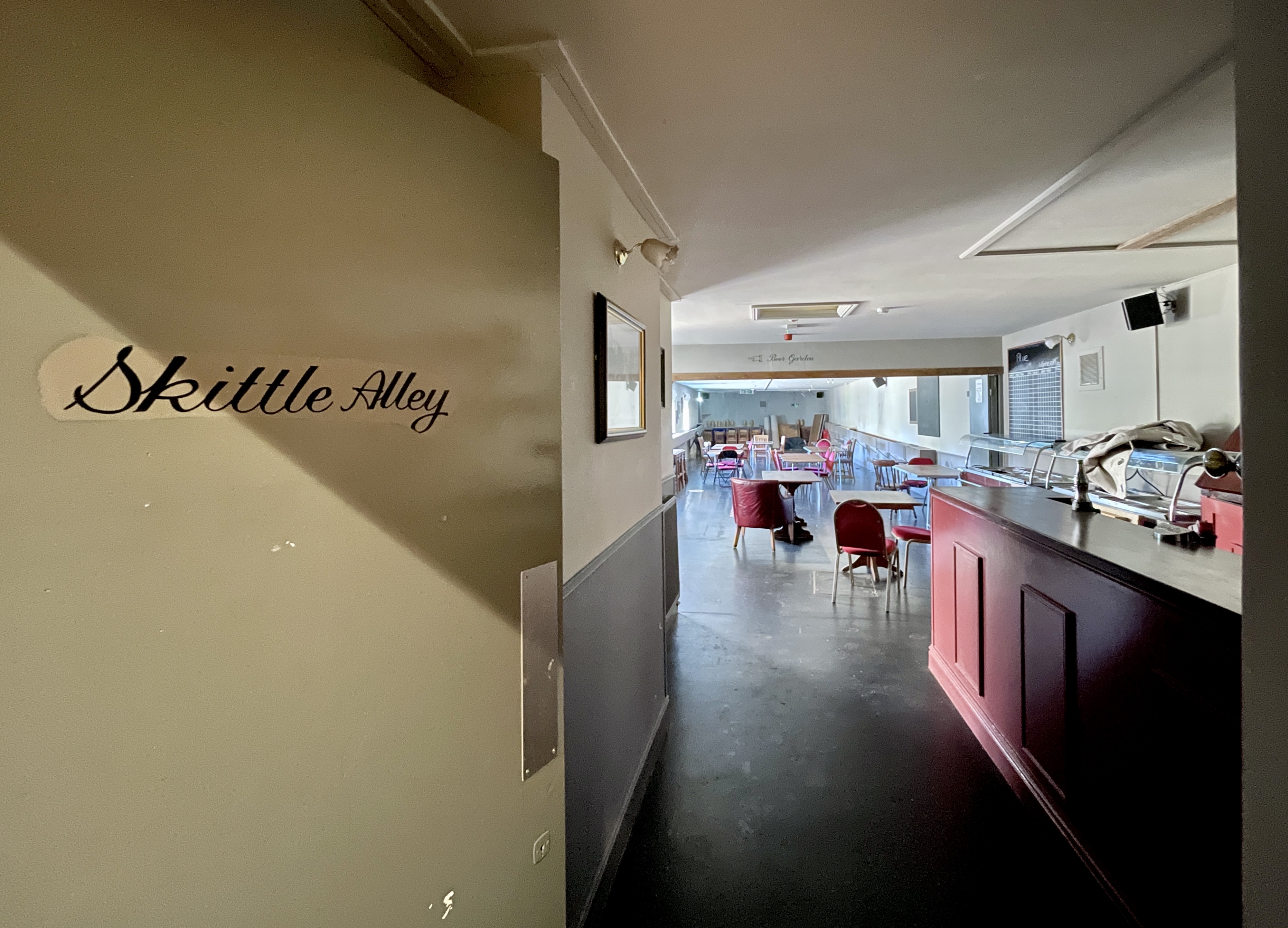
These last photos are from my first visit to the pub, a very busy Sunday lunchtime session several years ago. As you can see, the Bell is a Skittles pub. The Skittle Alley to the rear of the pub was in use when I visited, not for a regular league match though, more likely a Cup match or perhaps the unique and very traditional Sunday casual session which seems to be a feature of skittles pubs everywhere. The alley itself is quite compact, but behind the curtains on the right of this photo is a much larger function room that helps accommodate players during a match.

At the last count the Bell hosted four mens teams, playing Mondays and Wednesdays in the Worcester Friendly Skittles League, with Ladies skittles on Thursday evenings. Of course Skittles of all kinds remains in stasis at this time, though it's anticipated that league play will resume in September for the Winter season. It can't come soon enough for pubs like the Bell.


The 'Stickers' or 'Stickers-Up', usually young family members from local teams, are paid a small sum to set the pins on match days. Many leagues have a separate competition at the end of the season just for the Stickers, thereby ensuring interest in the game continues into the next generation.

Friday, 9 July 2021

Princess Royal, Taunton, Somerset


One of the few positives to emerge from this past year of chronic disruption and uncertainty in the pub trade, has been the truly remarkable show of resilience and creativity that licensees and staff have shown, when any number of the them would have been forgiven for throwing in the towel. I doubt whether I'm the only one who thought the twin ills of an out of control pandemic and an economy on the slide would be the final nail in the coffin for literally thousands of pub businesses, and of course a boom time for property companies looking to cash in on our precious pub heritage. That so many pubs have continued to trade whenever possible, coping with severely limited opening whilst jumping through innumerable logistical hoops imposed by a largely clueless government, gives hope that this particular national institution can rise to the challenge and weather whatever is thrown at it. 

Nevertheless, pubs and clubs continue to close, in some cases permanently, and clearly we're very far from out of the woods with this terrible pandemic just yet. After an initial rush back to the pub this Summer, trade does seem to have slowed somewhat, and it's now more difficult than ever to find a pub open at the less busy times of the week/day. So when we do find a pub maintaining the traditions of all-day opening, with a warm welcome and nice cool pint on a hot midweek afternoon, as I did in Taunton quite recently, it's certainly something worth shouting about I think.


The Princess Royal is one of those sturdy four-square town boozers that seem ever-present and immovable in the urban landscape, and yet so many of them have been lost to other retail or business use in recent years. Located slap-bang in the middle of Somerset's county town of Taunton, and barely a boundary-strike away from the County Cricket Ground, it wasn't actually on my itinerary that day, but the pub looked so bright, inviting, and perhaps most crucially, open, I felt I just had to pop in for a pint. The promise of 'Pub Games' was something of a draw too, albeit that it's still very much the off-season for most of these traditional pub pastimes.


From the appearance and location of the central entrance (above), I'd hazard a guess that the Princess Royal would have been a classic two-room town centre boozer, probably until the 80's when the vogue for knocking through pubs was at its height. Originally part of the long-gone Hanbury & Cotching pub estate, it could almost have been the Brewery Tap given how close the pub would have been to the old Canon Street Brewery. This would date the pub to the early part of the last century, probably pre-war given that the brewery was closed and it's pub estate sold to Starkey, Knight & Ford Ltd in 1923. Starkey, Knight & Ford would itself fall prey to a predatory national brewer, the brewery and brands discarded and the pub estate swallowed up by Whitbread in the 1960's, latterly becoming part of the Punch estate.

The pub we see today is the result of a recent refurbishment, triggered as it was by the retirement of licensees Tim Prosser and Patricia Stone who'd run the pub as a traditional local for 25 years. In fact the pub has changed hands a couple of times since then, the makeover and reopening under new management unfortunately coincided with the very start of the lockdowns and restrictions that have dogged the trade for the last 18 months. So when I visited in June, the pub had only recently reopened again, with new licensees Reece Short and Beth Sandford busy preparing for what has subsequently become a highly successful run of games for the home nation in the European Football Championship.


With social distancing rules in place for another couple of weeks at least, pubs of all sizes are having to be very careful and creative around the potential for crowding, particularly during large sporting events like the EUROs. Some of the more traditional West Country pubs are better equipped than most to deal with these issues thanks to their (currently mothballed) Skittle Alleys. The Princess Royal is one such pub, with a substantial Twin Skittle Alley/Function Room that's currently being put to good use as an overspill to the main bar when things get a bit too busy.


Alley Skittles like this has a long history of play in the West Country, and it remains very popular today. Whilst the game would have initially developed as an add-on to many pubs in the 19th century, often making use of old outbuildings and former stabling, I'd guess that the alley at the Princess Royal was built as part of the original pub, such was the ubiquity of the game in the early 20th century. Whether it was a twin alley as it is now is hard to say, perhaps the two were squeezed in later to accomodate the growing popularity of the game in the post-war years when pubs themselves enjoyed a peak of popularity.

Under normal circumstances, the Skittle Alley at the Princess Royal would be in use throughout much of the week. Both the right-hand and left-hand alleys are used to accomodate around four mens teams, playing Tuesday evenings in the St Austell Brewers Skittles League (formerly the Taunton Brewers League). Ladies play Monday nights in the Taunton & District Ladies League, and of course there are numerous cup and knockout tournaments to be squeezed in around the league action. Let's hope that once the football has finished, and social distancing restrictions finally relaxed, the Skittle Alley at the Princess Royal will once again host this most social of traditional pub games, and enjoy the extra trade that skittles brings to pubs throughout the West Country.


Tuesday, 16 March 2021

Rose & Crown, Bradford Abbas, Dorset

If Bradford Abbas is the archetypal sleepy English rural village, then the Rose & Crown certainly fits the bill as its typical English village pub (though far from sleepy when a skittles team are at home). A 14th century boozer of mellow local stone, firmly planted at the centre of the village in the shadow of the parish church. In fact the Rose & Crown is a proper old 'Inn' with several letting rooms, a long rambling bar and dining area, attractive beer garden, and entirely typical for a Dorset pub, a historic and very well-used Skittle Alley. I didn't see it myself, but I wouldn't be at all surprised if there were 'Good Stabling' available at the pub too, such is the timeless feel of the place.

My first, and thus far only visit to the 'famous' Rose & Crown was over four years ago now, part of a whistle-stop tour of towns and villages in beautiful Dorset. It also marked my first, and quite probably last truly competitive game of 'West Country Alley Skittles', the traditional game played at pubs and clubs all through the West Country and beyond. This version of skittles is the countrys most popular and well supported by some degree, but it's one that I have little experience of, and even less skill at playing if truth be known.

I spent an eventful night at the pub in August that year, playing skittles for the home team at the behest of my Dorset skittling buddy John Penny, a man who's even more enthused by traditional pub games than I am, if that's possible! John has captained teams at the Rose & Crown for longer than anyone cares to remember, playing Summer and Winter in the local Yeovil Skittles Leagues. A good player by all accounts, though clearly a very poor judge of form given that he was happy to sign me up as a reserve player for the 2016 Summer league. This bad judgement continued when he actually picked me to make up the numbers for a Division 4 league match, playing in the middle order for the 'Merkins' at the business end of the Summer season! I guess that even in the skittling hotbed of Dorsetshire, there's more to playing the game than merely winning, and I was delighted to accept the challenge.


So there's John (above), showing his best side and setting the pins for a few practice rounds on the Rose & Crown alley ahead of the big night. As it was I didn't entirely embarrass myself, though the team charitably offered me a bye on the bewildering array of big-money forfeits that come with top competition like this. Missing the pins entirely, missing your 'spare' etc. I think I managed all of these, transgressions which usually carry a hefty fine. As a rank novice though, I managed to escape the skittle alley that night with almost all my pocket money intact. All the more loose change to lose in the hotly contested game of Three Card Brag in the bar later!

The Merkins, including the nights hard-working 'Sticker-Up' at the front
In fact we won the match that night, thanks in the main to consistent if unspectacular scoring from all team members. Other than myself of course, who scraped to a thoroughly average total of 40. But with just 7 points deciding the winners, I was simply relieved that I hadn't missed the pins entirely and thrown the whole match. As a former Northants Table Skittles player I must say that I found the etiquette of the game slightly odd. The whole team leaving the alley and decamping to the bar whilst the opposing players set their score is not what I'm used to. Of course that meant there was less scrutiny from the opposition, and hence a little less pressure to perform, which undoubtedly helped me with my debut game. The only barracking in Dorset Skittles seems to come from your own team mates!

I describe the pub itself as being famous, and famous it most certainly is, albeit amongst a fairly small circle of games and pub enthusiasts. The image shown here (right) is from one of two 1930's British Movietone films which feature the 'Old Men of Bradford Abbas', including four elderly gentlemen whose combined age of 357 seemed to present no obstacle to regular trips to their village local. Nor indeed a few 'hands' of skittles in the pubs ancient skittle alley or on the Devil Amongst The Tailors (below). Images of these 'Lads of the Village' were used in promotional material by Dorset brewers Eldridge Pope in the 60's and 70's, so it's quite possible you may have come across them before and wondered at their origin.


The 'Athletics' film features the 'Lads' throwing a few balls down the stone-walled alley, and it's thought that this may represent the earliest recorded footage of a game of skittles in progress, albeit one for the 'Four Sovereigns Stakes' and Movietone cameras rather than the cut and thrust of league competition. Perhaps John could resurrect the 'Stakes' at the pub for old times sake, though he might struggle to match the 357 age-total these days. They were made of sterner stuff back then it seems...

The 'Duck' trophy, traditionally awarded to those players with the skill to avoid hitting any skittle pins at all on their go. Luckily I avoided the Duck on this occasion...

Having a pub games enthusiast as thoroughly 'enthusiastic' as John Penny for a local, is surely a blessing for the licensees of the Rose & Crown. His enthusiasm extends to being a strong advocate of the local skittles tradition of course, but he's also a keen supporter of pubs in general through his writing (under a pseudonym) for The Visitor magazine, as well as other local beer and pub related publications such as CAMRA's Giant Dongle newsletter. I've heard he also enjoys the odd pint for the cause...

John has also turned his hand to making numerous high quality games such as the 'Norfolk Twister' shown here in the bar of the Rose & Crown. Fellow Pub Games enthusiast Arthur Taylor, author of 'Played At The Pub', is shown here spinning the game with the licensee (photo c/o John Penny). John has made quite a few of these old, traditional games of chance over the years, a game that is now extremely rare in its home county of Norfolk, yet surprisingly common in Johns home county of Dorset!

John and myself spin for something or other, probably the next round of beers

Monday, 16 November 2020

A Compendium of Pub Games Images - Pt.29

There really is no shortage of books, journals, blogs and other online writing about beer and brewing. It's a micro-genre with seemingly limitless potential for saying much the same thing, in slightly different ways, about a subject that's always attracted passionate interest, though perhaps none more so than in recent years with the arrival of so-called 'craft' beer. But then that's the very nature of the keen enthusiast, there's always another angle on your passion to write about, and rarely a shortage of fans to read about it. Quite why beer and brewing (and wine and spirits for that matter) generate such a demand for the written word, and yet the pub, the stage for so many of lifes dramas, trails so far behind, has puzzled me for many a year.

Pubs are certainly taken for granted, particularly by the 'locals' who use them more than most. Whilst enthusiasts like myself visit pubs just as often, if not more so than regular social drinkers, our 'passion' for the boozer is probably regarded as unusual, dare I say 'geeky' by the mass of regular pub-goers. So the pub, arguably as interesting a subject as the beer that passes over the bar, seems to be so deeply ingrained in normal day-to-day life that it's simply not regarded as being particularly newsworthy by most people, let alone worth taking the trouble to write about!

But if pubs are a neglected subject in print, it's perhaps ten-times so for traditional pub games which are rarely the subject of the written word. The current go-to book for the subject remains Played at the Pub by Arthur Taylor. This book was published over ten years ago now, and right now there seems little sign of a follow-up (although rumours persist that a book on skittles by Arthur is in the pipeline), which perhaps says something about the commercial viability of the subject. Slightly strange given that under normal circumstances, almost every day there are literally tens of thousands of men and women playing games at the pub, often competitively in long-established leagues. Yet this rarely warrants a mention, even in guides which feature the kind of pubs that rely heavily on league games play for their success. And it's not as if the field lacks personalities, just no one with the inclination to document them it would seem.

So we have to look to the past for information on these commonplace games. When the 'new' games of Darts, Billiards, and latterly Snooker took hold, there was a ready market for books on the subject. The cheap post-war booklet on Darts shown above even had a chapter on the humble game of Shove Ha'penny, presumably written for the benefit of wealthier folk venturing forth into a working class world of pubs and beerhouses they were probably unfamiliar with. The three-ball game of Billiards in particular spawned a whole library of books on technique and shots, often written by, or with the help of notable players of the day, and sponsored by the many cue sports manufactures at the time.

The booklet shown here is a War Office publication. This edition was produced in 1957, which was around the mid-point of the post-war conscription known as National Service. The many thousands of servicemen called-up at this time, when they weren't involved in peacetime duties at home or abroad, would have been pretty desperate for recreational diversion. This booklet covers the rules and practicalities of play for just about every team and competitive sport imaginable, but it's particularly interesting in the context of this blog for the inclusion of rules for Quoits and Skittles. The rules for Quoits were supplied by the English Quoiting Association, so pretty standard stuff that can be found easily enough elsewhere.

The Skittles section is a bit more interesting. The rules given are for the basic form of the game that'll be familiar to skittlers everywhere, but the equipment is for what's now known as Old English Skittles, heavy Hornbeam pins and discus-shaped Lignum Vitae 'cheeses'. A common enough game back then, but now played at just the one pub in Hampstead, London, to rules that are unique to the game (and the Cambridge Table Skittles League). Dimensions for the 'alley' and frame are included, as is a guide to felling the various broken skittle frames that is a major feature of this kind of skittles.


Another genre of books that really blossomed from the early 20th century onwards were guide books to the numerous 'Inns' of the country. Never 'pubs' mind! These were invariably produced for motorists, newly mobilised and eager to explore the more genteel highways and byways of Britain's countryside, possibly with a stopover in a traditional roadside Inn. Most are pretty dull affairs it must be said, focussing exclusively on 'famous old inns', market town hotels, and well-appointed roadhouses of the day. Not the back-street boozers and tumbledown village alehouses where drinking, Darts and Dominoes were the principal attraction.

This one from 1951 is better than most in that the focus is on Midlands Inns only, giving more detail than there would be in a national guide, and not merely a skim of the most upmarket or historic 'usual suspects'. The author was also keen to seek the assistance of the local brewers, which clearly put a different slant on things. There's a very good illustrated chapter on the breweries, as well as a rare acknowledgement that customers liked to play games, as shown in the terrific set of photographs shown below. I can't help thinking Norman Tiptaft really 'liked' pubs, even if the word Inns was probably more acceptable to the publishers.


This facsimile of an 18th century publication details the various games of Skittles once popular in rural areas of the country, presented with a moral zeal typical of 'educated' gentlemen of the time. It's a real eye-opener, and as clear an indication as your likely to find of what was regarded as the 'degeneration' of the game in Britain.

The author makes a strong argument for promotion of the 'manly exercise of skittle-playing' over the more 'effeminate' games lately introduced such as Cards and Dice. Games redolent of an '...over-fed age of people', their souls '...insipid with ease and sloth' leading to 'bog bellies, swelled legs, gouty feet, and other ailments of the loaded corpse'. Quite! Skittles is regarded as both good exercise, and in it's original form, a game of high skill and for recreation only, rather than an excuse to '...guzzle and drink'. Hmm!

The most basic version of the game of Skittles in this publication makes the current 3-ball, 9-pin standard played today seem like a childrens game in comparison (which is not to say that modern skittles is not a highly skilled game in experienced hands). The rules are, it must be said, quite bewildering to these eyes. There being different heights and scores for different pin positions in the frame, the highest scoring being the tall 'King Pin' at the centre, followed by the four corners or 'Nobles', then the 'Commons'. Even then, scoring depends on how the pins are actually toppled, the higher scores achieved by 'tipping' one pin onto another rather than being directly struck. It's fascinating if slightly impenetrable stuff, but perhaps the most interesting aspect of a book like this is that someone would take the trouble to travel the country and research the humble game of skittles at all!


That almost nothing on pub games ever makes it to print makes this hefty tome on a single West Country Skittles League all the more remarkable. Ron Holpin was heavily involved in the game in the Bristol area for much of the time this book covers, and as a local sports journalist, he obviously felt duty bound to record aspects of the Thornbury & District Skittles League that few others would even regard as noteworthy. It's a pretty dry affair for the most part it has to be said, details of every season, notable results, and the finishing league tables make up the bulk of the book (details that until recently would have featured in most local newspapers). But in amongst the dry detail are amusing anecdotes, and much social history around the game, those who play it, and of course the pubs and clubs where the game has been played in the immediate post-war years onwards. Whilst not exactly a bedtime thriller, it's a useful document, and would that all leagues produced something similar as a social document before the players who shaped the game are no longer with us.

Enthusiasm for the game of skittles, both competitively and as an important social pastime, is made clear throughout the book, even extending to a short chapter on 'other' skittles games. This includes the unique East Midlands game of Long Alley, illustrated with details of play and photographs of a game in progress (below). On a trip to the Midlands, Holpin visited notable Long Alley venue the Gate Inn at Loscoe in Nottinghamshire, arriving just as a game had commenced against Belpers Duke of Devonshire, a league match in the Belper & District Summer Skittles League. Outside of a handful of specialist pub games books, Arthur Taylors included of course, this may be the only time the humble, somewhat 'primitive' game of Long Alley Skittles has featured in print. The low-key nature of skittle alleys in Derbyshire and Nottinghamshire, often located outdoors and therefore easily missed by visitors, mean that this game is perhaps taken for granted more than most.


Saturday, 26 September 2020

Alma Tavern, Worcester

I guess it's inevitable that as the COVID lockdown was gradually eased, and businesses of all kinds finally allowed to reopen, some would question why pubs seemed to have been favoured ahead of other, perhaps equally deserving businesses and resources. In fact we know that there are some who question why pubs have been allowed to reopen at all given the potential for issues around alcohol and social distancing.

At this point I feel duty bound to disclose a personal interest. I love pubs! Pubs are important to me, perhaps more-so than they are to most regular pubgoers. Certainly I much prefer to drink my beer and cider in the mixed social environment of a pub rather than at home. But I also appreciate the way that pubs at their best are important social hubs, of huge importance to their locals as well as visitors like myself, and often the wider community through events and the huge amount of charitable fundraising that many pubs engage in. Of course if you don't like or use pubs, or merely view them as just another licensed restaurant option, this love of the pub might be a little difficult to understand.

Because pubs are not just about serving alcohol for profit, despite what certain sections of the popular press might have us believe. For some, particularly the elderly, they may be their only lifeline with a genuine shared social experience, and even those of us in a more privileged position still rely on the neutral space pubs provide for a genuinely 'open' social experience rather than a self-selecting, perhaps even insular one. Where else can you rub shoulders with such a wide social mix with the implicit understanding that conversation is not only possible, but often expected. Individually, pubs are special for all manner of reasons, but collectively the pub as a concept is special for entirely social reasons, something I believe may have become apparent to even the most casual of pubgoers during this dreadful pandemic. We can drink beer anywhere, the pub experience is only truly open to us at the pub.


Which brings me nicely to the Alma Tavern in Worcester and its hugely popular mascot Alma Bear. Along with all the nations pubs and clubs, the Alma closed its doors in May for what many of us believed at the time would be a relatively short time. As we now know, it would be months before a light appeared at the end of the lockdown tunnel. What has also become apparent is that many pubs, the Alma included, didn't just sit back on their laurels waiting for things to get better. A takeaway food and off-license service helped maintain a semblance of normality for many regular pubgoers, and many pubs have strived to maintain their connection with the local community through online events and charitable fundraising. Licensee of the Alma Tavern Will Bradley went one step further, taking to the streets as his alter-ego, Alma Bear!

While I was enjoying a pint and taking these photographs at the Alma Tavern recently, I was a little perplexed at the the almost constant tooting of car horns outside on the busy Droitwich road. That was until the barman helpfully explained about Alma Bear, the pubs locally famous furry mascot. Alma Bear was originally created by the licensee to help boost interest in the pubs Saturday Kids Craft Club, as well as being a popular attraction for childrens parties and the like. With the lockdown knocking all these initiatives on the head, Will decided that everybody could do with a bit of a cheer-up, taking Alma Bear 'on the road' with regular walkabouts in and around Worcester for socially distanced meet and greets. So Alma Bear was outside the pub that day, working the Saturday afternoon crowd, all thumbs-up and waves to great appreciation from the many travellers in and out of the city. Talk about popular! Practically everyone was waving back, huge smiles all round, a real tonic in these difficult times. This is what pubs at their best are all about, and this is why those of us who love them have welcomed the return of pub-going with such enthusiasm.


In common with almost all the pubs I've been to since reopening, the Alma has probably never looked better. De-cluttered and clean as a whistle, it's an attractive pub to be in even with the ubiquitous bar screens and social distancing signage. Another feature that's common to pubs at this time is the removal of the Dartboard. I doubt there's much of an issue around actually playing the game, more that it just doesn't fit in to the current social distancing regime where we're duty bound to choose a table and stay there as much as practicable. Televised sport is still on offer though, as is good food and a couple of decent real ales.

League Skittles and the pubs Skittle Alley are currently out of action too, but still serving a useful purpose as the pubs well-equipped function room, due to be pressed into service for the afternoon Football when I visited, part of managing the pub to help reduce crowding in the main bar areas.