Showing posts with label Shove Ha'penny. Show all posts

Monday, 3 May 2021

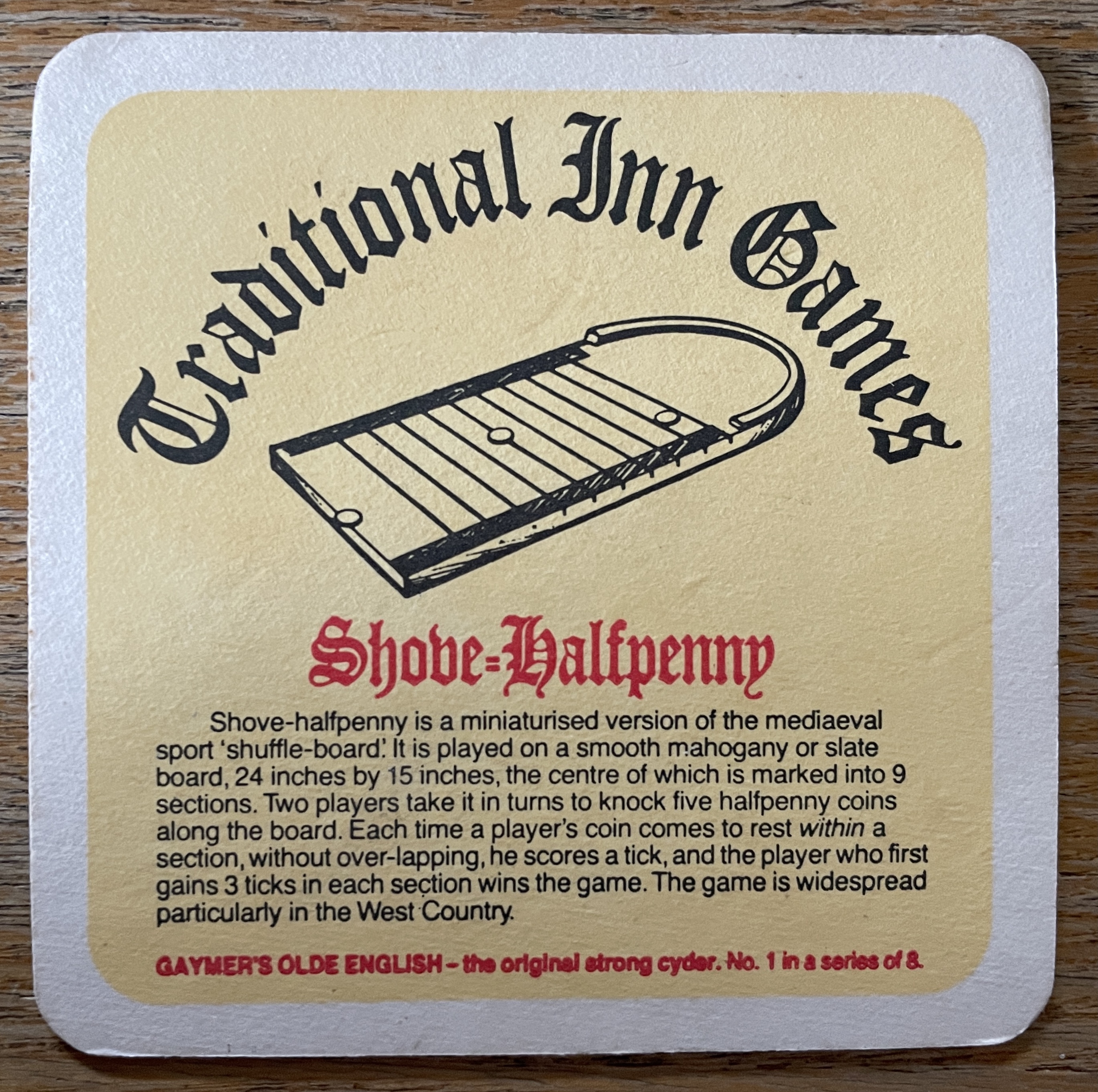
Traditional Inn Games - The Gaymer's Cyder Beermat Collection

Pub gaming ephemera and equipment has long been a medium for drinks and tobacco companies to advertise their wares. Playing Cards, Dominoes, Darts Flights and Scoreboards were all commonly appended with Brewery names and Tobacco brands, and along with league sponsorship there are few areas of the pub games tradition that would have escaped the marketing departments attention.

In truth, I doubt whether this kind of advertising was intended to sway drinkers and smokers one way or the other to any great degree, all pubs being very firmly tied to their respective breweries back then. I'd imagine that then, as now, drinker and smoker preference was based largely on personal taste, price, and choice of pub rather than the hard sell of an attractively branded Cribbage Board. These items were more about brand loyalty, cheap or free tokens available to customers as part of the all-important 'sales rep - licensee' relationship.

So customers got to play their favoured games at the pub without the added expense of having to supply their own equipment, and the drinks and tobacco industry obviously saw the value of rewarding valued customers with relatively inexpensive branded tokens of their appreciation, thereby cementing the relationship between brand and customer. The legacy of all this of course, is a healthy interest from enthusiasts of all things Brewery and Tobacco related, indeed some of these everyday items are worth quite a bit to collectors nowadays.

Occasionally, as shown here, the tables are turned and a drinks company enlists the help of traditional pub games to sell their products, in this case via the time-honoured method of the Beer Mat. Never ones to miss a trick, marketing departments know the value of a well placed 'info-mat', branded on one side, concisely informative on the reverse, and a last-resort bit of reading material in times of idle boredom at the pub. Make them a numbered set and you're guaranteed to want to read (or indeed collect) them all.


This set was produced by Gaymer's, probably around the time the brand was in the hands of Mathew Clarke in the 1990's. Olde English Cyder was a huge cider brand back then, the unique 'Costrel Barrel' keg fonts and false handpumps seemed to be on the bar counters of just about every pub, presumably the result of a massive marketing push, of which these mats would have played their part.

Eight in number, these beer mats feature Traditional Inn Games that would have been quite rare, or at the very least in serious decline even then. The descriptions are accurate enough though, such that I have to wonder who's work the marketeers drew more heavily on, Arthur Taylor or Timothy Finn!

Olde English Skittles (No.6) takes preference over more common variants of the game, presumably because of the 'Olde English' prefix fitted better with the cider brand being advertised. To say that 'The game still flourishes in certain parts of London' is somewhat fanciful. I think at this time there may have been just two, maybe three venues for the game, of which only one pub alley survives today (where it does indeed flourish).

I can't in all honesty say I've ever seen Nine Mens Morris (No.5) being played in the pub, though I have seen examples of the games unique board on occasion. The same cannot be said for Dominoes (No.4) of course, which is still one of the most popular games found in the pub, albeit that the mat refers to the 'Block' game rather than the more 'pubby' Fives & Threes version played competitively in pub and club leagues.

Dobbers (No.7) is a name rarely used these days for the game of Indoor Quoits depicted on this mat, and sadly even then it was probably almost extinct as a game in the Vale Of Evesham when these were in circulation. The game clings on in just a handful of reasonably well-supported leagues, located along the Welsh Borders area.

Shove Halfpenny (No.1), or Shove Ha'penny, is indeed widespread in that there are still many boards for the game in existence, though sadly not so many located at the pub these days. Competitive league play can still be found in the West Country, Wales, and in its Pushpenny variant, Lincolnshire and Sussex.

As stated on the mat, Quoits (No.3) remains relatively popular in certain parts of Northern England, though its status in East Anglia is now less certain. At one time regarded as a national sport to rival Football, the game remains a fantastic spectacle for the casual spectator during a Summer evenings play.

The final two mats are real curiosities. Tossing the Penny (No.8) still exists in a handful of pubs in Anglia, with one outlier at a pub in Rutland. A real glimpse of rural pub life, an unsophisticated game for farmers and villagers that's literally part of the furniture in those few pubs where the game survives. Similarly, Ringing The Bull (No.2) was a pub pastime created to while-away an afternoon or evenings drinking. Little more than a tethered copper Bull Ring and a hook, it's hard to imagine how the brewery and tobacco marketeers would have enlisted these two games to their cause.

Monday, 12 April 2021

The George, Ashley, Northamptonshire


It's the 12th of April, frosty Spring is just about giving way to the warm promise of Summer, and the pubs are finally open again! Or rather pub gardens are open, bar rooms and snugs are still deemed far too dangerous to linger in! Let's not be churlish though, a pub that's open in any form is clearly better than a pub that's closed, and from where I'm sitting today, at the pub, pint in hand, with the sun shining and temperatures set to rise later this week, the timing seems opportune.

Not only are we on the very cusp of British Summer time, when the great British beer garden really comes into its own, it seems to me that even the most single-minded drinks enthusiasts will have realised by now that drinking at home is not necessarily the greatest of drinks 'experiences'. I for one am bored rigid with popping fancy cans of beer at home, no matter how highly crafted the contents, and the long cold Winter has even deprived us of our own personal 'beer gardens', the closest many of us have come to a 'near-pub' experience this year. It's high time we got back to the pub!

The last time we were released from lockdown was a very different experience of course, given that we were free to drink and dine 'inside' the pub, albeit with a raft of rules and restrictions. Filled with enthusiasm and confident of fine Summer weather, I celebrated that day in July by taking a stroll along one of our long-distance footpaths to a nearby village pub. It was a truly memorable day at one of my favourite traditional pubs in the area, and one that I've been looking forward to repeating all through this latest Winter lockdown. So another trek across freshly ploughed and recently seeded fields seemed entirely appropriate today, and to yet another pub that's been a long-time favourite of mine.

The George

The George at Ashley was my local once. By which I mean a local in the true sense of the word. Not just a regular 'beer' haunt, nor indeed the pub on my doorstep, but the one I 'chose' to use two or three times a week in preference to many others nearby. A proper 'prop-up-the-bar' local, a chatty villagers local, a rugby and too many pints on a Saturday afternoon local. Not the only 'local' of its kind in the area it's true, but it was mine for a time, and I must say I loved it to bits.

Sparse description of The George from a 1990 CAMRA guide
In truth The George became my local because my 'actual' local at the time (which was truly 'local' being in my own village) finally closed its doors as a pub for good. I have to say that I was truly gutted at losing my beloved village local, so exchanging a 5 minute stroll to the pub for upwards of an hours trek to the next village seemed entirely reasonable at the time. A man's got to have his local!

The George was somewhere we liked to visit for a whole number of reasons. The flat road across the Welland floodplain made cycling or walking for a pint more of a pleasure than a chore, and the benches at the front were just the best place to rest our legs when we arrived, down a few pints, and watch the local horses clop by. The pub also became a favoured destination for the Friday night warm-up session when the infamous Welland Valley Beer Festival was in full swing. Sadly that memorable event became a victim of its own success, but I'm sure many will remember with great fondness the beer tent and BBQ at the rear of the pub.

Later on we made the George our home for afternoon rugby matches on the telly, taking an old Shove Ha'penny Board along for a few half-time games that would inevitably extend well beyond the final whistle! Rugby at the George was always a treat given the pubs position near the Leics/Northants border. Ostensibly a Tigers pub, there was always a good few Saints fans in for the banter too. Later on a Devil Amongst The Tailors table made the journey across the valley, a favourite with children in the bar, and therefore a firm favourite with the parents too!

So what of the George now. What changes has it seen over the years since my first visit almost 20 years ago. Well the George is still essentially the same 'improved' farmers bar it's always been. An alehouse in a very small village, little altered over the years but now spruced-up and with much more of a food aspect. The traditional Northants Skittles Table that graced the tiny rear bar is long gone (though I understand it's still located in the village). A brass strip set into the quarry tiled floor marks the original throwing point, probably the only clue there was ever a skittles table at the pub. Until recently there was also a well-used Dartboard in the bar, the pub fielding a strong team in the local Welland Valley Darts League. Sadly the Dartboard seems to have gone, but then it's a very small bar and space is clearly at a premium.


Another feature of the pub that may or may not have survived the recent lockdowns is the weekend Dominoes game. A group of perhaps half a dozen folk from villages round and about were always to be found rattling the tiles on a Saturday and/or Sunday afternoon, the sound of village locals everywhere until recent years. The game of Fives & Threes is open to anyone that likes a game, in fact I sat in on a game one afternoon with typically mixed results!

So the games have largely gone, but in new hands it's still very much the pub it's always been. Open Monday to Sunday, and remarkably for a village pub, that includes lunchtime hours every day of the week, even Mondays! A pub for the locals, but also a destination pub with a strong food offering. You're still welcome to pop in for a drink though, or will be when restrictions on inside drinking are finally lifted in May. I may not be a local anymore, but there's still a bench at the front for horse and tractor watching, and I can see myself walking across the fields to the George quite a lot this year.

Easter Monday Tradition

 
Until the recent COVID disruptions, the George played it's part in an important local sporting tradition. Many will have heard of the Easter Bottle Kicking event between nearby Hallaton and Medbourne villages, a rivalry said to date from Pagan times! What's not so well known is the traditional Tug of War between the villagers of Ashley & Medbourne that usually takes place on the morning of the Bottle Kicking. Mens, Womens, and a Childrens competition have been held, the winners of the Mens match, a best of three, claiming the bragging rights and a shield on the spirit barrel trophy shown here. There is also a wooden Ice Bucket trophy for the Womens competition, both of which were held at the George when I first started visiting. 


Saturday, 6 March 2021

The Shove Ha'penny Control Association


Not much is known about the grandly titled Shove Ha'penny Control Association, which is perhaps surprising given how widespread the game was in pubs and clubs until relatively recent times. As yet, no-one has managed to unearth an archive of minutes and transactions for this auspicious control body, neither have any trophies, awards, or league tables come to light bearing their name. So it's a bit of a mystery just who or what the Association believed they were actually controlling!

In reality, there probably never was a Shove Ha'penny Control Association. More likely it was an opportunistic invention of one or more manufacturers, a clever marketing ruse designed to boost sales of their own 'official' boards as opposed to 'inferior' homemade and locally crafted ones, or indeed those sold by their many competitors.

In the post-war years when the game was at its most popular, there were one or two short-lived attempts to develop the game through national competition. The News of the World organised competitions for a number of popular pub games, most notably Darts but also Shove Ha'penny. Some regional and world competitions still occur to this day, and several regional champions of the game can be seen shoving for a big money prize on Yorkshire Televisions fabulously un-PC Indoor League series in the 70's. But other than these rare moments in the spotlight and a handful of local leagues which still exist, the game remains resolutely one for casual play at the pub, without the need for 'control' by an association of any kind.

This very heavy slate bears the Shove Ha'penny Control Association moniker in cast aluminium, and was the very first board I acquired. It's still a particular favourite of mine even though it doesn't get a great deal of use these days, being far too heavy to carry to the pub. The slate itself is very smooth and in remarkably good condition for its age. The Patent number for this and the token shown below dates the design to around 1929, a time when the game would have been very popular in pubs and clubs.

There's plenty of additional design on this board to warrant the patent, including rubber 'cushions', a handy depression to hold your chalk (right) and numbered beds, presumably for a scoring game. This appears to have been the Rolls Royce of manufactured Shove Ha'penny slates. There was also a cheaper 'Challenger' model without the numbering, and the design was either adapted or copied for later slates with plastic surrounds replacing the expensive aluminium of the originals, and sometimes branded for tobacco products (below). Many of these slates were supplied drilled ready for screwing to a table top, not strictly necessary given the enormous weight so possibly more of a guard against theft.


Serious league play, of the kind the Shove Ha'penny Control Association were presumably aiming to foster, requires a stringent set of rules leaving no room for ambiguity or dispute. Before play began, the 'Number of Beds' required for a win would have to be chalked into this circle, a verbal agreement simply wouldn't do. Needless to say, these boards are the only ones I've seen with this unnecessary design quirk.

The manufacturers of these boards were not ones to miss a trick, making special Shove Ha'penny Tokens for use in place of the age-old solution of a plain old ha'penny. These bespoke tokens are made from a thin disc of Brass with milled edges, the top side nickel silvered and cast to indicate the 'official' nature of what is essentially a brass washer! To be fair, they do work very well, once again removing a lot of the unpredictability of using a mixed-bag of old coinage with differing thickness and weight.

The Rules of the Game of Shove Ha'penny

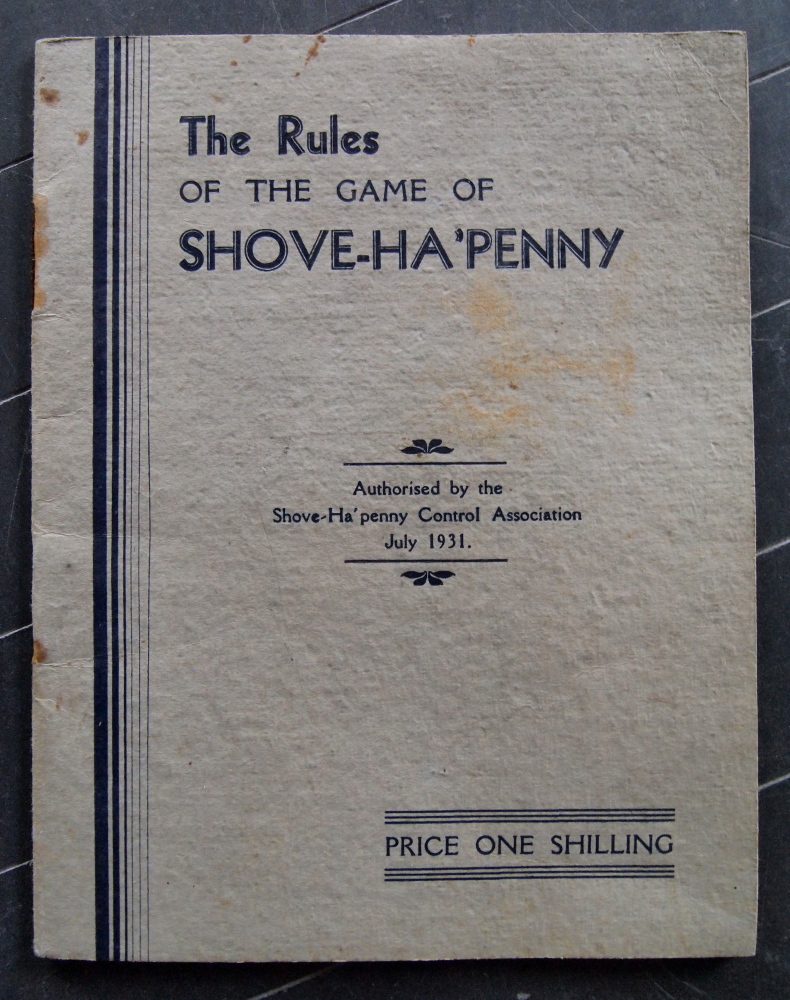
Since writing this piece almost ten years ago, little if any additional information has come to light about the Shove Ha'penny Control Association, though boards and tokens continue to come up for sale, an indication of how popular these relatively expensive items would have been. However, I recently acquired what would have been the 'official' rules for the game as prescribed by this 'august' body. Dated 1931, and with what seems a hefty shilling price-tag for such a slim volume of rules that presumably most players knew already! This booklet was originally included in the purchase of one of these slate boards, along with two sets of the Official Discs of the Shove Ha'penny Control Association. The rules themselves are pretty standard, in fact they're almost identical to a set of rules produced at a later date by John Jaques & Son Ltd, including the unusual 'Handicapping' system shown below. More interesting are the adverts that have been included in the booklet, the sum of which go a long way to answering the question of what the Shove Ha'penny Control Association actually was...

There's no mention of who actually manufactured these boards, either on the slates themselves or within the rules, but usefully there are a number of other items advertised that give a strong clue. These include slate scoreboards for Billiards and Darts, as well as two designs of slate-shelved Meat Stores, the 'Eureka' and 'Colstor'. Just a little research online confirms what Arthur Taylor had already revealed in his excellent 'Played At The Pub' book, that all these slate items were produced by Goddard & Son, producers of Slate and Slab products from a base in Battersea, London. Goddard supplied slate beds to many of the Billiard table manufactures of the time, Mr R.S Goddard himself inventing the unique ‘Multum In Parvo' (Much in Little) practice Billiard Table that the mighty Thurston Billiard Table manufacturer developed. I think this finally puts to rest the idea that the ‘Association’ was anything other than a bit of opportunistic marketing by a successful family business, attempting to exercise some measure of control, and therefore extend their interests in, the burgeoning market for competitive Shove Ha'penny.

The war years were a peak time for the game of Shove Ha'penny. A staple of village Tap Rooms and Public Bars almost everywhere. Boards were also supplied to the military, and the RAF in particular, for servicemen's recreation at home and overseas (a rare 'Wide Arrow' stamped board I acquired is now in the Jaques of London private games collection). So an inexpensive, highly skilled traditional pastime that quickly joined the ranks of pub and club league competition, and needless to say caught the eye of businessmen that were ever-alert to the potential of a new games market to be exploited.

I'd say that the vast majority of Shove Ha'penny (and Pushpenny) boards that are still played in pubs, or have subsequently come up for sale, are homemade or at best locally made by a skilled woodworker. Often re-purposed from redundant furniture or perhaps a cut-down bar counter, and as the name suggests, played using the smallest currency of the day. Little opportunity for money to be made from the game then, other than the pints that accompany an afternoon game or evening league match. Hence the desire here to codify the game, and sell the idea of just one 'official' manufacture of true 'league standard' boards and discs. Other manufacturers certainly produced boards in great quantities around this time, mostly from what Goddard infers as 'inferior' Mahogany, but only Goddard & Son attempted to take control of the game as a serious competition by producing 'definitive' rules, and 'league standard' slate boards of a patented design.


That there are so many of these slate Shove Ha'penny boards still out there is of course a testament to the (albeit limited) success of this strategy, as well as the undoubted quality of the boards themselves, It's clear however that Goddard, via their Shove Ha'penny Control Association, didn't in fact achieve the control of league competition they appear to have sought. Perhaps there just wasn't the desire from players to follow Darts as a standardised national game.

This rules book shows there were three designs of Shove Ha'penny Board available, the top quality 'Players' at £2:2:0, the 'Challenger' at £1:5:0, and the 'Imp' (right), the most basic slate at just 8/6. I have a couple of these Imp slates, they're very common, but I had no idea until now that they came from the same stable as these more expensive boards.

Friday, 5 February 2021

A Shove Ha'penny Restored

The traditional bar-room games of Shove Ha'penny and Pushpenny are probably the ones I'd most like to see revived at the pub. These are games of skill and strategy rather than luck, games for long, boozy afternoons with friends, as well as the sober competition of local league play. They take up almost no additional room in the bar, and are games that people of all ages, myself included, seem to enjoy immensely when given the chance to play them. Very good quality old and modern boards are common and cheap to acquire if you know where to look, and needless to say, the old adage that it takes 'minutes to learn, but a lifetime to master' holds true with these simple shoving games.

I've got a few of these old boards myself, most of which have seen some action over an afternoon pint or two. In truth, I've got way more planks of highly polished hardwood with lines scored into them than I'll ever need, but as with most things in life, when you see one that takes your fancy it's hard not to buy yet another example for the collection.

Take this board for example, a typically unloved 'vintage' Shove Ha'penny that caught my eye for a number of reasons. It's quite a large one for a start, clearly handmade by an enthusiast of the game. It's these 'shed-built' boards that interest me the most, and when well-used and not too mucked-about with, they often play better than manufactured boards. It's the reclaimed timber that it was made from that's determined the oversize nature of this board. The rougher underside (below) suggests a series of Oak planks, possibly an old cupboard door or bar counter, an early example of upcycling what might otherwise have been burned.

I think it's fair to say that whoever made this board was probably not a woodworker by trade. Most of the handiwork is solid and functional, made from whatever offcuts were to hand rather than from scratch. It looks homemade rather than 'crafted', but nevertheless it's a handsome thing that I felt needed bringing back into use with a little tlc. Because old Shove Ha'penny boards like this often come with a few problems that need fixing.

The principal issue I had with this board was the entirely unnecessary coat of clear varnish that had been slopped onto the surface. Varnish, no matter how carefully applied, is rarely an appropriate surface for a Shove Ha'penny Board. At best it's too smooth for a polished coin to glide across properly, no wood-grain leading to a lack of airflow under the coins which tends to make them 'dig-in' or stick. Worse still is when the varnish is rough and/or sticky, making it an unacceptably slow board. The very best wooden Shove Ha'penny boards are either entirely untreated, or at most 'naturally' polished. The patina of age developing over many years of play, the only 'polish' coming from beer and tobacco stained hands 'rubbing-up' the surface, certainly not the addition of wax or worse. A naturally smooth Shove Ha'penny or Pushpenny board gives a fast, even, precision playing surface that lifts the game to another level in skilled hands. So the first job was to get the paint stripper out and carefully remove this varnish layer, a long and tedious job, but well worth the effort.

That someone took the trouble to mount two George V Pennies into the board was another selling point for me. Pointless embellishments like this are just the kind of thing I'd do myself if I was making something similar, though given this is a Shove Ha'penny, I like to think I'd get the denomination right! Nevertheless, it's a nice touch. Another feature that's more often seen on homemade Shove Ha'pennys is the drilled holes down each side of the board. These are designed to take small pegs or matchsticks for scoring, three per bed, and typically for a homemade board these are more than a little higgledy-piggledy. It's an interesting touch but not one I tend to favour for scoring, a small piece of chalk does the job in a much less fiddly way.


After several hours of careful scraping, rubbing and scrubbing with white spirit and fine grade wire wool, this was the finished playing surface revealed. Even now it has a few minor, and one more serious issue. The actual grain is lovely and smooth making it a reasonably 'fast' board, but it's not exactly an 'even' surface. There are a few knots in the wood that would probably be unnacceptable for competition, and the odd gentle undulation here and there, but to be honest these don't affect the progress of coins up the board to a significant degree.

The major issue is a crack that has unfortunately lifted a little toward the top end of the playing surface. I say 'crack', it's actually where the planks of wood have been joined and have shrunk back a little over time, a common occurrence in Shove Ha'penny's made from multiple pieces of timber rather than a single solid board (though single piece boards are more liable to warp). This crack is a problem, though it certainly doesn't make the board unplayable. At some point I'll have to take an orbital sander to the surface and even things up.


The final job was fitting a baton to the underside, the 'table stop' that may or may not have existed before but was certainly missing when I bought it. This is a tricky job that if done badly can ruin the board, and particularly tricky when the timber is relatively thin, as it is here. If the screws used are too long, or you've countersunk the holes just a little bit too generously, there's every chance the steel tips will protrude onto the playing surface, something of a disaster that thankfully I managed to avoid on this occasion.

Monday, 16 November 2020

A Compendium of Pub Games Images - Pt.29

There really is no shortage of books, journals, blogs and other online writing about beer and brewing. It's a micro-genre with seemingly limitless potential for saying much the same thing, in slightly different ways, about a subject that's always attracted passionate interest, though perhaps none more so than in recent years with the arrival of so-called 'craft' beer. But then that's the very nature of the keen enthusiast, there's always another angle on your passion to write about, and rarely a shortage of fans to read about it. Quite why beer and brewing (and wine and spirits for that matter) generate such a demand for the written word, and yet the pub, the stage for so many of lifes dramas, trails so far behind, has puzzled me for many a year.

Pubs are certainly taken for granted, particularly by the 'locals' who use them more than most. Whilst enthusiasts like myself visit pubs just as often, if not more so than regular social drinkers, our 'passion' for the boozer is probably regarded as unusual, dare I say 'geeky' by the mass of regular pub-goers. So the pub, arguably as interesting a subject as the beer that passes over the bar, seems to be so deeply ingrained in normal day-to-day life that it's simply not regarded as being particularly newsworthy by most people, let alone worth taking the trouble to write about!

But if pubs are a neglected subject in print, it's perhaps ten-times so for traditional pub games which are rarely the subject of the written word. The current go-to book for the subject remains Played at the Pub by Arthur Taylor. This book was published over ten years ago now, and right now there seems little sign of a follow-up (although rumours persist that a book on skittles by Arthur is in the pipeline), which perhaps says something about the commercial viability of the subject. Slightly strange given that under normal circumstances, almost every day there are literally tens of thousands of men and women playing games at the pub, often competitively in long-established leagues. Yet this rarely warrants a mention, even in guides which feature the kind of pubs that rely heavily on league games play for their success. And it's not as if the field lacks personalities, just no one with the inclination to document them it would seem.

So we have to look to the past for information on these commonplace games. When the 'new' games of Darts, Billiards, and latterly Snooker took hold, there was a ready market for books on the subject. The cheap post-war booklet on Darts shown above even had a chapter on the humble game of Shove Ha'penny, presumably written for the benefit of wealthier folk venturing forth into a working class world of pubs and beerhouses they were probably unfamiliar with. The three-ball game of Billiards in particular spawned a whole library of books on technique and shots, often written by, or with the help of notable players of the day, and sponsored by the many cue sports manufactures at the time.

The booklet shown here is a War Office publication. This edition was produced in 1957, which was around the mid-point of the post-war conscription known as National Service. The many thousands of servicemen called-up at this time, when they weren't involved in peacetime duties at home or abroad, would have been pretty desperate for recreational diversion. This booklet covers the rules and practicalities of play for just about every team and competitive sport imaginable, but it's particularly interesting in the context of this blog for the inclusion of rules for Quoits and Skittles. The rules for Quoits were supplied by the English Quoiting Association, so pretty standard stuff that can be found easily enough elsewhere.

The Skittles section is a bit more interesting. The rules given are for the basic form of the game that'll be familiar to skittlers everywhere, but the equipment is for what's now known as Old English Skittles, heavy Hornbeam pins and discus-shaped Lignum Vitae 'cheeses'. A common enough game back then, but now played at just the one pub in Hampstead, London, to rules that are unique to the game (and the Cambridge Table Skittles League). Dimensions for the 'alley' and frame are included, as is a guide to felling the various broken skittle frames that is a major feature of this kind of skittles.


Another genre of books that really blossomed from the early 20th century onwards were guide books to the numerous 'Inns' of the country. Never 'pubs' mind! These were invariably produced for motorists, newly mobilised and eager to explore the more genteel highways and byways of Britain's countryside, possibly with a stopover in a traditional roadside Inn. Most are pretty dull affairs it must be said, focussing exclusively on 'famous old inns', market town hotels, and well-appointed roadhouses of the day. Not the back-street boozers and tumbledown village alehouses where drinking, Darts and Dominoes were the principal attraction.

This one from 1951 is better than most in that the focus is on Midlands Inns only, giving more detail than there would be in a national guide, and not merely a skim of the most upmarket or historic 'usual suspects'. The author was also keen to seek the assistance of the local brewers, which clearly put a different slant on things. There's a very good illustrated chapter on the breweries, as well as a rare acknowledgement that customers liked to play games, as shown in the terrific set of photographs shown below. I can't help thinking Norman Tiptaft really 'liked' pubs, even if the word Inns was probably more acceptable to the publishers.


This facsimile of an 18th century publication details the various games of Skittles once popular in rural areas of the country, presented with a moral zeal typical of 'educated' gentlemen of the time. It's a real eye-opener, and as clear an indication as your likely to find of what was regarded as the 'degeneration' of the game in Britain.

The author makes a strong argument for promotion of the 'manly exercise of skittle-playing' over the more 'effeminate' games lately introduced such as Cards and Dice. Games redolent of an '...over-fed age of people', their souls '...insipid with ease and sloth' leading to 'bog bellies, swelled legs, gouty feet, and other ailments of the loaded corpse'. Quite! Skittles is regarded as both good exercise, and in it's original form, a game of high skill and for recreation only, rather than an excuse to '...guzzle and drink'. Hmm!

The most basic version of the game of Skittles in this publication makes the current 3-ball, 9-pin standard played today seem like a childrens game in comparison (which is not to say that modern skittles is not a highly skilled game in experienced hands). The rules are, it must be said, quite bewildering to these eyes. There being different heights and scores for different pin positions in the frame, the highest scoring being the tall 'King Pin' at the centre, followed by the four corners or 'Nobles', then the 'Commons'. Even then, scoring depends on how the pins are actually toppled, the higher scores achieved by 'tipping' one pin onto another rather than being directly struck. It's fascinating if slightly impenetrable stuff, but perhaps the most interesting aspect of a book like this is that someone would take the trouble to travel the country and research the humble game of skittles at all!


That almost nothing on pub games ever makes it to print makes this hefty tome on a single West Country Skittles League all the more remarkable. Ron Holpin was heavily involved in the game in the Bristol area for much of the time this book covers, and as a local sports journalist, he obviously felt duty bound to record aspects of the Thornbury & District Skittles League that few others would even regard as noteworthy. It's a pretty dry affair for the most part it has to be said, details of every season, notable results, and the finishing league tables make up the bulk of the book (details that until recently would have featured in most local newspapers). But in amongst the dry detail are amusing anecdotes, and much social history around the game, those who play it, and of course the pubs and clubs where the game has been played in the immediate post-war years onwards. Whilst not exactly a bedtime thriller, it's a useful document, and would that all leagues produced something similar as a social document before the players who shaped the game are no longer with us.

Enthusiasm for the game of skittles, both competitively and as an important social pastime, is made clear throughout the book, even extending to a short chapter on 'other' skittles games. This includes the unique East Midlands game of Long Alley, illustrated with details of play and photographs of a game in progress (below). On a trip to the Midlands, Holpin visited notable Long Alley venue the Gate Inn at Loscoe in Nottinghamshire, arriving just as a game had commenced against Belpers Duke of Devonshire, a league match in the Belper & District Summer Skittles League. Outside of a handful of specialist pub games books, Arthur Taylors included of course, this may be the only time the humble, somewhat 'primitive' game of Long Alley Skittles has featured in print. The low-key nature of skittle alleys in Derbyshire and Nottinghamshire, often located outdoors and therefore easily missed by visitors, mean that this game is perhaps taken for granted more than most.