Showing posts with label Old English Skittles. Show all posts

Monday, 3 May 2021

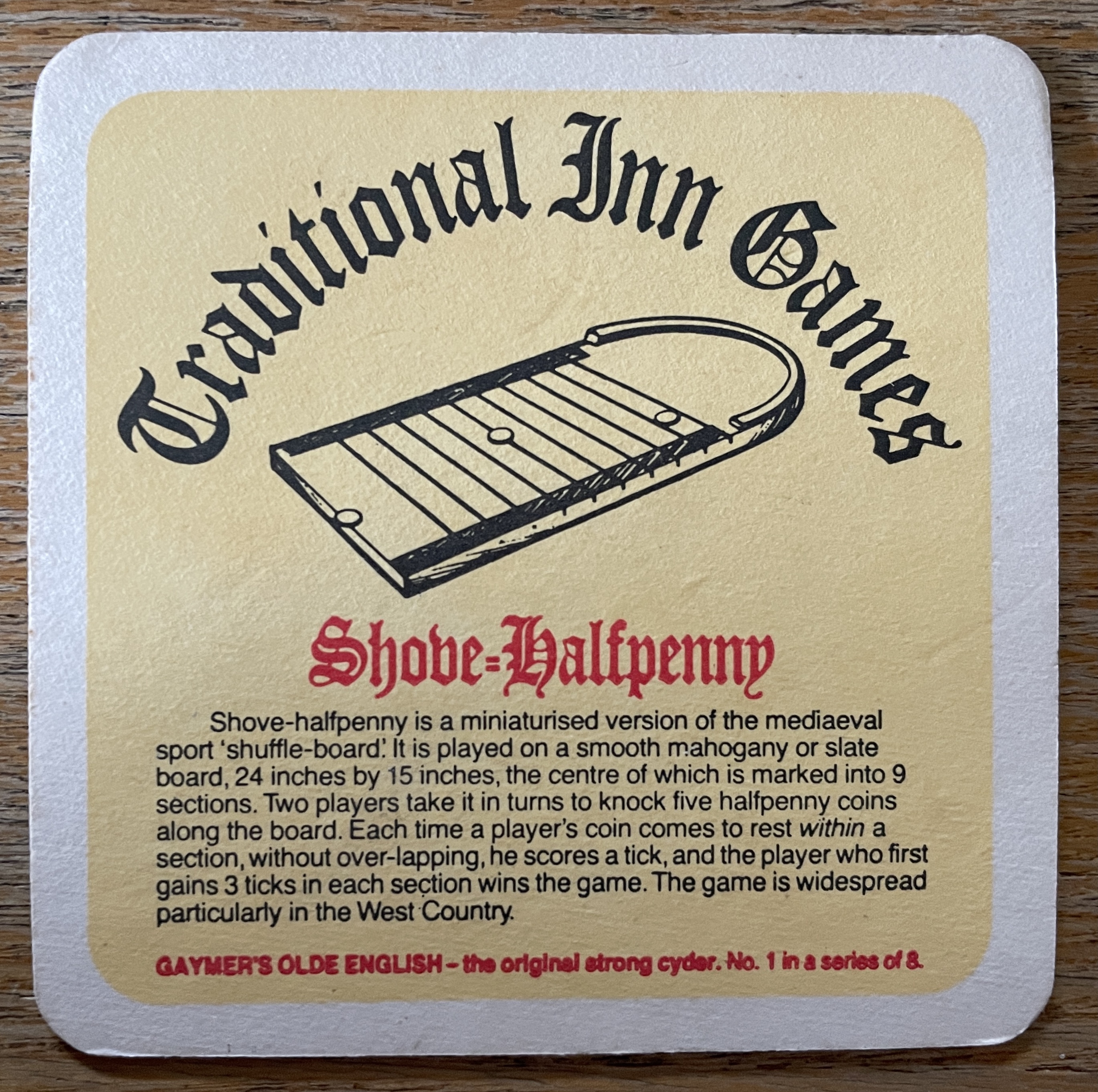
Traditional Inn Games - The Gaymer's Cyder Beermat Collection

Pub gaming ephemera and equipment has long been a medium for drinks and tobacco companies to advertise their wares. Playing Cards, Dominoes, Darts Flights and Scoreboards were all commonly appended with Brewery names and Tobacco brands, and along with league sponsorship there are few areas of the pub games tradition that would have escaped the marketing departments attention.

In truth, I doubt whether this kind of advertising was intended to sway drinkers and smokers one way or the other to any great degree, all pubs being very firmly tied to their respective breweries back then. I'd imagine that then, as now, drinker and smoker preference was based largely on personal taste, price, and choice of pub rather than the hard sell of an attractively branded Cribbage Board. These items were more about brand loyalty, cheap or free tokens available to customers as part of the all-important 'sales rep - licensee' relationship.

So customers got to play their favoured games at the pub without the added expense of having to supply their own equipment, and the drinks and tobacco industry obviously saw the value of rewarding valued customers with relatively inexpensive branded tokens of their appreciation, thereby cementing the relationship between brand and customer. The legacy of all this of course, is a healthy interest from enthusiasts of all things Brewery and Tobacco related, indeed some of these everyday items are worth quite a bit to collectors nowadays.

Occasionally, as shown here, the tables are turned and a drinks company enlists the help of traditional pub games to sell their products, in this case via the time-honoured method of the Beer Mat. Never ones to miss a trick, marketing departments know the value of a well placed 'info-mat', branded on one side, concisely informative on the reverse, and a last-resort bit of reading material in times of idle boredom at the pub. Make them a numbered set and you're guaranteed to want to read (or indeed collect) them all.


This set was produced by Gaymer's, probably around the time the brand was in the hands of Mathew Clarke in the 1990's. Olde English Cyder was a huge cider brand back then, the unique 'Costrel Barrel' keg fonts and false handpumps seemed to be on the bar counters of just about every pub, presumably the result of a massive marketing push, of which these mats would have played their part.

Eight in number, these beer mats feature Traditional Inn Games that would have been quite rare, or at the very least in serious decline even then. The descriptions are accurate enough though, such that I have to wonder who's work the marketeers drew more heavily on, Arthur Taylor or Timothy Finn!

Olde English Skittles (No.6) takes preference over more common variants of the game, presumably because of the 'Olde English' prefix fitted better with the cider brand being advertised. To say that 'The game still flourishes in certain parts of London' is somewhat fanciful. I think at this time there may have been just two, maybe three venues for the game, of which only one pub alley survives today (where it does indeed flourish).

I can't in all honesty say I've ever seen Nine Mens Morris (No.5) being played in the pub, though I have seen examples of the games unique board on occasion. The same cannot be said for Dominoes (No.4) of course, which is still one of the most popular games found in the pub, albeit that the mat refers to the 'Block' game rather than the more 'pubby' Fives & Threes version played competitively in pub and club leagues.

Dobbers (No.7) is a name rarely used these days for the game of Indoor Quoits depicted on this mat, and sadly even then it was probably almost extinct as a game in the Vale Of Evesham when these were in circulation. The game clings on in just a handful of reasonably well-supported leagues, located along the Welsh Borders area.

Shove Halfpenny (No.1), or Shove Ha'penny, is indeed widespread in that there are still many boards for the game in existence, though sadly not so many located at the pub these days. Competitive league play can still be found in the West Country, Wales, and in its Pushpenny variant, Lincolnshire and Sussex.

As stated on the mat, Quoits (No.3) remains relatively popular in certain parts of Northern England, though its status in East Anglia is now less certain. At one time regarded as a national sport to rival Football, the game remains a fantastic spectacle for the casual spectator during a Summer evenings play.

The final two mats are real curiosities. Tossing the Penny (No.8) still exists in a handful of pubs in Anglia, with one outlier at a pub in Rutland. A real glimpse of rural pub life, an unsophisticated game for farmers and villagers that's literally part of the furniture in those few pubs where the game survives. Similarly, Ringing The Bull (No.2) was a pub pastime created to while-away an afternoon or evenings drinking. Little more than a tethered copper Bull Ring and a hook, it's hard to imagine how the brewery and tobacco marketeers would have enlisted these two games to their cause.

Monday, 16 November 2020

A Compendium of Pub Games Images - Pt.29

There really is no shortage of books, journals, blogs and other online writing about beer and brewing. It's a micro-genre with seemingly limitless potential for saying much the same thing, in slightly different ways, about a subject that's always attracted passionate interest, though perhaps none more so than in recent years with the arrival of so-called 'craft' beer. But then that's the very nature of the keen enthusiast, there's always another angle on your passion to write about, and rarely a shortage of fans to read about it. Quite why beer and brewing (and wine and spirits for that matter) generate such a demand for the written word, and yet the pub, the stage for so many of lifes dramas, trails so far behind, has puzzled me for many a year.

Pubs are certainly taken for granted, particularly by the 'locals' who use them more than most. Whilst enthusiasts like myself visit pubs just as often, if not more so than regular social drinkers, our 'passion' for the boozer is probably regarded as unusual, dare I say 'geeky' by the mass of regular pub-goers. So the pub, arguably as interesting a subject as the beer that passes over the bar, seems to be so deeply ingrained in normal day-to-day life that it's simply not regarded as being particularly newsworthy by most people, let alone worth taking the trouble to write about!

But if pubs are a neglected subject in print, it's perhaps ten-times so for traditional pub games which are rarely the subject of the written word. The current go-to book for the subject remains Played at the Pub by Arthur Taylor. This book was published over ten years ago now, and right now there seems little sign of a follow-up (although rumours persist that a book on skittles by Arthur is in the pipeline), which perhaps says something about the commercial viability of the subject. Slightly strange given that under normal circumstances, almost every day there are literally tens of thousands of men and women playing games at the pub, often competitively in long-established leagues. Yet this rarely warrants a mention, even in guides which feature the kind of pubs that rely heavily on league games play for their success. And it's not as if the field lacks personalities, just no one with the inclination to document them it would seem.

So we have to look to the past for information on these commonplace games. When the 'new' games of Darts, Billiards, and latterly Snooker took hold, there was a ready market for books on the subject. The cheap post-war booklet on Darts shown above even had a chapter on the humble game of Shove Ha'penny, presumably written for the benefit of wealthier folk venturing forth into a working class world of pubs and beerhouses they were probably unfamiliar with. The three-ball game of Billiards in particular spawned a whole library of books on technique and shots, often written by, or with the help of notable players of the day, and sponsored by the many cue sports manufactures at the time.

The booklet shown here is a War Office publication. This edition was produced in 1957, which was around the mid-point of the post-war conscription known as National Service. The many thousands of servicemen called-up at this time, when they weren't involved in peacetime duties at home or abroad, would have been pretty desperate for recreational diversion. This booklet covers the rules and practicalities of play for just about every team and competitive sport imaginable, but it's particularly interesting in the context of this blog for the inclusion of rules for Quoits and Skittles. The rules for Quoits were supplied by the English Quoiting Association, so pretty standard stuff that can be found easily enough elsewhere.

The Skittles section is a bit more interesting. The rules given are for the basic form of the game that'll be familiar to skittlers everywhere, but the equipment is for what's now known as Old English Skittles, heavy Hornbeam pins and discus-shaped Lignum Vitae 'cheeses'. A common enough game back then, but now played at just the one pub in Hampstead, London, to rules that are unique to the game (and the Cambridge Table Skittles League). Dimensions for the 'alley' and frame are included, as is a guide to felling the various broken skittle frames that is a major feature of this kind of skittles.


Another genre of books that really blossomed from the early 20th century onwards were guide books to the numerous 'Inns' of the country. Never 'pubs' mind! These were invariably produced for motorists, newly mobilised and eager to explore the more genteel highways and byways of Britain's countryside, possibly with a stopover in a traditional roadside Inn. Most are pretty dull affairs it must be said, focussing exclusively on 'famous old inns', market town hotels, and well-appointed roadhouses of the day. Not the back-street boozers and tumbledown village alehouses where drinking, Darts and Dominoes were the principal attraction.

This one from 1951 is better than most in that the focus is on Midlands Inns only, giving more detail than there would be in a national guide, and not merely a skim of the most upmarket or historic 'usual suspects'. The author was also keen to seek the assistance of the local brewers, which clearly put a different slant on things. There's a very good illustrated chapter on the breweries, as well as a rare acknowledgement that customers liked to play games, as shown in the terrific set of photographs shown below. I can't help thinking Norman Tiptaft really 'liked' pubs, even if the word Inns was probably more acceptable to the publishers.


This facsimile of an 18th century publication details the various games of Skittles once popular in rural areas of the country, presented with a moral zeal typical of 'educated' gentlemen of the time. It's a real eye-opener, and as clear an indication as your likely to find of what was regarded as the 'degeneration' of the game in Britain.

The author makes a strong argument for promotion of the 'manly exercise of skittle-playing' over the more 'effeminate' games lately introduced such as Cards and Dice. Games redolent of an '...over-fed age of people', their souls '...insipid with ease and sloth' leading to 'bog bellies, swelled legs, gouty feet, and other ailments of the loaded corpse'. Quite! Skittles is regarded as both good exercise, and in it's original form, a game of high skill and for recreation only, rather than an excuse to '...guzzle and drink'. Hmm!

The most basic version of the game of Skittles in this publication makes the current 3-ball, 9-pin standard played today seem like a childrens game in comparison (which is not to say that modern skittles is not a highly skilled game in experienced hands). The rules are, it must be said, quite bewildering to these eyes. There being different heights and scores for different pin positions in the frame, the highest scoring being the tall 'King Pin' at the centre, followed by the four corners or 'Nobles', then the 'Commons'. Even then, scoring depends on how the pins are actually toppled, the higher scores achieved by 'tipping' one pin onto another rather than being directly struck. It's fascinating if slightly impenetrable stuff, but perhaps the most interesting aspect of a book like this is that someone would take the trouble to travel the country and research the humble game of skittles at all!


That almost nothing on pub games ever makes it to print makes this hefty tome on a single West Country Skittles League all the more remarkable. Ron Holpin was heavily involved in the game in the Bristol area for much of the time this book covers, and as a local sports journalist, he obviously felt duty bound to record aspects of the Thornbury & District Skittles League that few others would even regard as noteworthy. It's a pretty dry affair for the most part it has to be said, details of every season, notable results, and the finishing league tables make up the bulk of the book (details that until recently would have featured in most local newspapers). But in amongst the dry detail are amusing anecdotes, and much social history around the game, those who play it, and of course the pubs and clubs where the game has been played in the immediate post-war years onwards. Whilst not exactly a bedtime thriller, it's a useful document, and would that all leagues produced something similar as a social document before the players who shaped the game are no longer with us.

Enthusiasm for the game of skittles, both competitively and as an important social pastime, is made clear throughout the book, even extending to a short chapter on 'other' skittles games. This includes the unique East Midlands game of Long Alley, illustrated with details of play and photographs of a game in progress (below). On a trip to the Midlands, Holpin visited notable Long Alley venue the Gate Inn at Loscoe in Nottinghamshire, arriving just as a game had commenced against Belpers Duke of Devonshire, a league match in the Belper & District Summer Skittles League. Outside of a handful of specialist pub games books, Arthur Taylors included of course, this may be the only time the humble, somewhat 'primitive' game of Long Alley Skittles has featured in print. The low-key nature of skittle alleys in Derbyshire and Nottinghamshire, often located outdoors and therefore easily missed by visitors, mean that this game is perhaps taken for granted more than most.


Thursday, 4 June 2020

Pub Game Trophies & Medals - Pt.1

The rewards for winning in pub game play are usually 'token' at best, rarely of significant monetary value. In fact most of the trophies awarded to individuals today are practically valueless, mass-produced plastic, purely symbolic, though no less important to those who receive them of course. Small cash prizes are sometimes awarded, indeed I recall winning a few quid as runner-up in a pairs cup competition in my local Table Skittles League. I'm not sure this is a widespread thing, it certainly came as something of a surprise to me at the time.

The real prize for victorious teams and individuals in local competition is the proud legacy of achievement. That, and getting your name engraved on what are often impressive league trophies or shields, joining a list of previous winners that may stretch back over many decades of play, perhaps even a century or more! In days gone by you might also expect to see your name in the local newspaper. The chat and banter of a social night out at pub or club, and the outside-chance of a bit of glory and local bragging-rights are everything in pub games.

Until relatively recently, prizes would have been both symbolic, and often of genuine monetary value. The huge number of mostly silver medals and trophies awarded in local competition from the late 19th century and throughout much of the 20th century, is testament to how much more important these games would have been to participants back then. It's hard to gauge just how valuable these medals would have been in their day, after all, they may have been made from silver (occasionally gold!), but there's very little weight to them, and practically all were 'struck' or 'cast' rather than individually 'crafted' by the jewellers and medallists who made them. But they're certainly medals in the true sense of the word, recognition in precious metal of success in what may have been a very tough competition over the course of a season or cup run.

So, reasonably valuable tokens that would have been awarded in large quantities almost everywhere games were played competitively. Precious enough to the individuals who won them that they wouldn't have been simply discarded, but perhaps not valuable enough for the melting pot. As such they're quite common now, and come up for sale in the antiques and collectibles trade all the time, albeit they're not quite as common as those for 'sporting' prowess such as Football, Cricket, or Athletics. Over the years I've acquired a few of these medals, the images on the front and little scraps of social history engraved on the rear make them attractive items to collect and research. Each one has a story to tell, though deciphering that story can often prove difficult given the chronic lack of information on pub games leagues in archives and online sources. Here are a few examples from my collection.

This medal (above & left) is an interesting one. Probably made by Vaughton Ltd, a jeweller and medallist that's still trading in Birmingham today. Whilst I've failed to discover anything about the I S Skittles Club (Islington?), what's striking about this medal is the image on the front which appears to show a gentleman about to hurl a weighty discus-shaped 'Cheese' at a set of very large skittle pins. The size/shape of the pins and the layout of the alley all point toward this representing the almost extinct game of Old English Skittles, famously still played at the last remaining pub alley for the game at the Freemasons Arms in Hammersmith, London. This style of skittles was very common around the war years which is when this medal would have been awarded, and yet this is one of only two examples that I've come across, both by Vaughton Ltd with an identical skittling image. It's important to note that the image on the front of a medal is no guarantee that it represents the version of skittles actually played in the league it was awarded for. It may simply be that this was the standard medal for all skittles games supplied by Vaughtons, and for this reason it's not wise to draw firm conclusions about the specific games they might represent.

A good example of this is the medal shown here which appears to represent the popular 'West Country' game of alley skittles. The figure, clearly holding a round ball, is lining-up to 'bowl' at a set of typically dumpy alley skittles. The slatted alley is also 'Western' in style. However, this medal was actually awarded to the winner of the 1944/5 season in the Syston Skittles League, a league of longstanding in the 'Long Alley Skittles' county of Leicestershire. I think we can be reasonably sure that the league would have been playing Long Alley at this time, a very different type of skittles that's certainly not the one represented on this medal.

Dominoes is perhaps the most humble of all pub games, yet even this warranted medals made of silver. An inexpensive game played casually as well as competitively, but a game with something of an image problem, particularly with the young. Both Dominoes and Cards are games that younger pub-goers take little interest in, unless of course there's a stake to be won. Back in 1959 when this medal was struck by Fattorini & Sons Ltd, a small bit of silver would have been ample reward for a seasons play. The medal shown here seems to be for the most common pub Domino game, Fives & Threes given that the 6-3 and double 5 are the most important scoring tiles in the game.


The 1930's were the time when Darts really took off in Britain, and by the 40's it seems every pub had a board, if not a team actually playing in a local league. The 'sport' was widely promoted with booklets detailing how to play, numerous sponsored competitions with cash prizes, as well as hugely popular exhibition matches. There was even a highly irritating song extolling the virtues of the game. So this medal by W H Haseler Ltd of Birmingham (1938) was one of the earlier examples of its kind, which perhaps explains the rather poor rendering of the game itself. The Dart is somewhat oversized, the Board rather too small and perhaps closer in detail to a target than a true Dartboard. Darts represents the most common of all pub game medals, most of which feature a simple rendering of a Dartboard on the front, though earlier examples like this one tend to concentrate on the player as much as the board. There is still a Hornsea & District Ladies Darts League.


Table Skittles medals don't seem to turn up as often as those for other skittle games. Perhaps this is down to the more local/regional nature of the game in comparison to alley skittles which is widespread. The medal above is a modern example made from base metal, and has a fairly accurate rendering of a classic Northamptonshire 'Hooded' Skittles Table. Again, this is the only one of its kind that I've thus-far come across, appropriately enough at a Car Boot sale in the county. Slightly odd given that I've scoured antiques centres, fayres and flea markets in Northants for several years without success. I gather that small trophies, plaques and shields are awarded for Table Skittles these days, and attractive as they are, I'm not sure what folk would actually do with a medal like this one now. When the awarding of medals was at its peak, most players would have wore pocket watches. This explains why small medals like this are often known as Fob Medals or Medallions, because they were designed to be displayed on a watch chain.

This silver medal is also clearly for Table Skittles, though careful examination reveals a slightly different form of the game has been depicted. This medal was struck by Thomas James Skelton of Birmingham & Chester in 1933, and at this time there would have been several local variants of the game of Table Skittles. This table has no 'Hood' like the Northamptonshire game, and the table is longer and perhaps narrower, in fact more in the style of the Kentish game Daddlums. This unique skittles game is almost extinct now, but would have been very popular and quite common throughout the South East at the time this medal was awarded. Again, it's hard to draw firm conclusions about the game that this was actually presented for, and sadly the detailed inscription on the back has proved little help in this regard, but if this is a medal for Daddlums competition it may prove to be something of a rarity. I don't doubt there are other medals for this game out there somewhere, but as yet I've failed to find them.