Thursday, 11 February 2016

Three Pubs For Northamptonshire Table Skittles

The Skittles alcove at The Pioneer
Skittles, in all its myriad forms and regional variations, is a game of wide social appeal. Perhaps more than any other traditional pub game, throwing things at a set of wooden pins is something that everyone seems to enjoy. A simple game to understand, and there's likely to be a version within the capabilities of almost anyone. I believe that skittles is also more socially inclusive than other pub games, even at league level where teams can be drawn from all social classes and age levels, male or female. Anyone can have a go, no experience necessary.

Northamptonshire Table Skittles is one of the most widely played of all the skittle games. This is partly due to the fact that the unique tables used for the game are often permanently located in the more public areas of pubs and clubs, and therefore generally always available for play. The presence of a Northamptonshire Skittles Table in the corner of a bar, club, or even at the local village fete, is guaranteed to attract attention, and there seems to be no strata of society that won't happily 'chuck' a cheese given the opportunity.

The three pubs that I've featured here are representative of the wide spectrum of pub-types found in Northamptonshire. Only high-end gastro venues and city-centre bars are missing, styles of 'pub' which are unlikely to feature on this blog given the almost complete lack of games available, or indeed any recognisable 'pubiness' in most cases. From a late 20th century housing estate local, to a village destination dining pub, what links these three pubs is the presence of Northamptonshires most traditional pub game, and the fact that they are all most definitely 'pubs' in the very best sense of the word.


The Pioneer in Northampton is a classic two-room estate pub of a type which was once common throughout the country. Built in the 1970's at a time when it would have been inconceivable to construct a new housing estate without including the everyday essentials of Pub, Shop, and Chippy, these new-build locals would be the social hub of freshly minted communities.

Sadly it's pubs just like The Pioneer that are now closing their doors for good, and at a truly alarming rate. Estate pubs of this kind have always been shunned by beer enthusiasts and family diners alike, but for many it's their core local trade that is now drifting away, preferring a night in with cheap supermarket booze and the telly over the added value of social interaction that the local pub offers.

The Pioneer seems to be doing OK though. The classic mix of weekday evening games and weekend entertainment keeping the locals happy. Pubs like The Pioneer are also often the last bastions of league Skittles play, the game having been pushed out of the town centre and into the suburbs to a large degree.


For many people, particularly visitors to the county, it's attractive old village pubs like the Griffins Head at Mears Ashby that they most strongly associate with rural Northamptonshire. The village itself is a typical mix of stone cottages and larger buildings associated with the local country estate. The Griffins Head sits at the centre of all this, totally at ease with its bucolic surroundings.

Few village pubs these days that don't rely heavily on the food trade for their success, and of course many have gone the whole hog and become gastro-pubs, little more than licensed restaurants in fact. The Griffins Head is certainly a popular destination for dining, but it's still very much a pub with a distinct bar area and an adjacent games room with Darts and the pubs vintage Skittles Table.


The Skittles Table, a WT Black & Son model, dates from 1955. All but the very earliest Blacks tables carry this information and more stencilled on the timbers underneath (above), so do have a look next time you see a table in a pub.

Sixty-plus years of having hardwood 'cheeses' thrown at it will have taken its toll of course, and the table was reconditioned by an S Webb of Northampton at some point in its recent past. The table needs to be in good condition because it still see's regular use in the 3rd Section of the Wellingborough & District Skittles League.


If you went looking for Northamptonshire's very own traditional game in the pubs and bars of the county town, you might be forgiven for thinking the game had finally died out. I know of only one pub table within the confines of the inner ring road, but there are several to be found a little further out, including a fine old Blacks table just over the river at the Pomfret Arms.

The pub gets barely a mention in the 1990 edition of CAMRA's guide to real ale pubs in the county. A Belhaven pub at the time, presumably with no real ale to speak of, the pub is listed without a description so it's hard to say whether skittles has returned to the pub or is a new feature. Given that most of the towns pubs would have had a skittles table at some point, it's more likely that the game has returned, and with it league play. The Pomfret is also firmly on the beer map given that a micro-brewery now operates from outbuildings to the rear of the pub. This helps make the Pomfret a great venue for a casual game of Northampton's finest contribution to traditional pub gaming.

Saturday, 30 January 2016

Royal Oak, Whitecroft, Gloucestershire


Tracking down pubs which feature the increasingly rare game of indoor Quoits can be a difficult task. The more common pub games such as Skittles and Darts are frequently represented online with league or team websites, and even thoroughly local or regional games such as Toad in the Hole and Aunt Sally are well covered, venues for play relatively easy to find. Quoits on the other hand is almost invisible outside of the relatively small number of pubs and clubs where the game is now played.

Of the handful of Quoits leagues which still exist, most are relatively isolated from each other. The Hereford League extends no further than the town itself, and those based at Kington, Clee Hill, and the Welsh borders are hardly near neighbours. The most isolated of all seems to be the Forest of Dean League, an area which has seen a good-few pub closures in recent years, and a rapidly shrinking number of venues for the game in those that are still open.

In the absence of a website for the forest league, I went looking for the Miners Arms in Whitecroft, a pub well-known to me for its impressive cider range, but which also held the promise of a Quoits board. Unfortunately for me the pub has been thoroughly refurbished in recent years, and the Quoits Board is sadly long-gone. It's a very good pub nonetheless, noted for fine dining and with a good skittle alley to the rear. Following a half of strong local cider, the staff were happy to point me in the direction of the villages current hotbed of league Quoits play, the Royal Oak.

Not knowing much about the pub, I must admit that I approached with an element of caution. Was it a welcoming pub? Were the locals friendly? I needn't have worried, the welcome was as warm as the impressive open fire, and the locals were a chatty bunch, carrying the mildly amused look of villagers well used to visitors like ourselves.

Pride of place in the main bar area is the pubs Quoits Board, a white painted slab of aggregate, sitting on top of a standard steel frame strung with netting to catch errant quoits. This all-white colour scheme, as opposed to the more common red and green, seems to be traditional to the Forest of Dean area. Four rubber quoits are available for play, and a home-made scoreboard sits adjacent to the board, the use of which may need some explaining if like me you tend to play a simple point-scoring game.


These scoreboards come in all manner of different styles, but they all perform the same basic task. In league play, the idea is to score each of the numbers on the board. 1-12 in the case of this one, but other leagues have higher or lower numbers. Four quoits are thrown, the outer ring of the Quoits Board scoring 1, the inner 2, and the bolt or 'Hob' scores 5. The maximum score is therefore 20. On each throw, the combination of scores from the four quoits is totalled and this numbered flap on the scoreboard is claimed as yours, should it be available. Your opponent cannot now score that number. The winner is the one with the highest total of numbers that they have claimed throughout the game.

One other point of note is the Quoits themselves. The standard for play everywhere as far as I can tell is a set of four flat rubber rings, white on one side, black the other. Quoits need to land white-side up to score. Two of the quoits on the board at the Royal Oak may once have been white on one side, but after many years of active service they're now more of a deep tobacco brown.

The other two quoits are interesting in that they are black on both sides, but moulded in such a way that they have a concave and convex side. In fact they look identical to the Steel Quoits that this indoor game was originally modelled on. Perhaps this is how all rubber quoits would have been at one time, indeed I've read elsewhere that they were originally made from stitched leather, making it easier to shape the quoits in this way. The white sided quoits we see now were presumably easier and cheaper items to produce.

Quoits is currently played by nine teams in seven venues in the Forest of Dean, and you can catch the cut-and-thrust of league play on Wednesday evenings throughout the summer and winter months. The Royal Oak would be an ideal venue to view the spectacle, which I'm led to believe can be very competitive.


The Royal Oak is also home to the Royal Acorns team in the Royal Forest of Dean Ladies Skittles League, as well as The Wurzels mens team. Pool is played in the Forest of Dean Pool League

Sunday, 17 January 2016

A Darts Roundup

A clutch of wooden spoons in Darts & Dominoes at The Boat, Whittlesey, Cambridgshire
The Waterside Inn

The Waterside Inn sits on the very edge of Mountsorrel village in rural north Leicestershire, separated from it in fact by a broad loop of the River Soar. It's this section of navigable river that defines the pub and supplies much of its trade, sitting as it does overlooking a deep lock and moorings, and a narrow hump-back bridge which connects the pub to the village. Truly a waterside inn then.

So it's perhaps no great surprise that this is predominantly a destination dining venue. Indeed much of the pubs layout is given over to dining, and this along with the tidy riverside garden accounts for most of the pubs trade, particularly during the busy summer months.

Noteworthy in the context of this blog is that there's also a wonderfully traditional 'snug' at the bridge end of the pub (above). A smaller space reserved for the more intimate business of chat and a pint, and an object lesson in how to develop a pub in a way that fully exploits its location and business opportunities without removing all the essential pubbiness that makes the place attractive in the first place. For me it's this small room that is the very heart of the pub, a place I felt instantly at home in, and no doubt a favourite with seasoned boaters moored up for the night. There's also a Dart Board, which seals the deal for me.

The Cross Foxes

I've featured a few of Shrewsburys attractions on this blog before, most notably the historic and unspoilt Loggerheads in the heart of the old town. But there's more to Shrewsbury than the admittedly attractive and historic town centre. Across the river and south of the English Bridge is a cluster of pubs in the suburbs of Coleham and Bell Vue, including the Prince of Wales which has also featured here, and one or two proper locals pubs worth searching out.

The Cross Foxes (below) consists of a single tidy bar room, and is very much an old school social drinking pub. Good beer, conversation, and when I popped in for an afternoon pint of Bass 'the horses', hold sway in the bar, so it'll come as no surprise that the bar room staples of Darts & Dominoes are very popular at the Cross Foxes. Indeed a casual afternoon game of Darts was in progress as I supped my pint, and numerous trophies are dotted around the pub.

The St Dunstan Darts League was a London based league associated with the St Dunstan's war veterans charity, established to help men and women blinded in service to their country (now called Blind Veterans UK). In 1945 a sighted team known as the Dunstan Four was formed by the then chairman of the West Islington Darts League Harry Allen, who toured the country raising money for the charity in popular exhibition matches. The associated league helped the fund raising efforts in pubs and clubs throughout Greater London, and a successor to the league continues today in the form of the Salisbury & District Darts League which raises money for Wiltshire Sight.

The Junction Arms, league winners in 1950, seems to have been located on Junction Road, Upper Holloway, and was renamed the Drum & Monkey within 15 years of this medal being struck. Following a period of closure the pub reopened fairly recently as the Oak & Pastor, a typically pleasant London pub, tastefully refurbished, but without any sign of a Dart Board as far as I can tell!


The Railway

I used to make a regular pilgrimage to the Leicestershire village of Ratby, principally for pints of excellent Marston's Pedigree at the wonderfully unspoilt Plough. Tucked away off the main street and overlooking a common, the Plough was a real treat. Quarry tile floors, drilled bentwood seating, beautifully kept beer, and a Pool Table that kept us amused for far too many pints it must be said. The Plough is still worth a visit though much of the original interior was altered during an early 90's refurbishment. Gaming interest here is in the form of Petanque and a Dart Board in the dining room!

Of the three pubs which remain in the village, the Bulls Head retains a very attractive snug/bar and its traditional Skittle Alley, but for me it's the Railway (above) that hits the spot now. There's a lovely little railway themed back bar (the Pullman Lounge), and a more basic public bar which is where the Dart Board and associated trophies can be found.

The Hop Pole straddles the border between Beeston and Chilwell in Nottinghamshire. Darts is played on Monday evenings in the smaller 'Beeston' bar.
Brass barrels and feathered flights. A set of 'Tournament Darts' from St Albans based Kwiz Darts Ltd. Production ceased toward the end of the 20th century when slimmer tungsten alloy Darts superseded brass.

Saturday, 9 January 2016

Castle & Falcon, Newark

Outside of the more upmarket gastro venues and town centre managed bars, most pubs still include games as part of their offering, even if it's just a Dart Board or a set of Dominoes perched on the windowsill. They may not attract the attention of customers in the way they once did, but it's good that so many licensees still see traditional pub games as part of what makes the British pub such a unique and special place. Of course publicans like to see their Darts and Cribbage Boards in use, not least because it ensures steady custom over the course of a few pints, and in the case of league play, a welcome bit of trade on the less busy days of the week.

For some pubs, such as the Castle & Falcon featured here, the gaming is more than just an element, it's pretty much the whole point of the pub. It's also a major part of why this pub in particular continues to thrive where others have struggled or even closed in recent years. That and the fact it's a popular, well run locals pub that's equally welcoming to visitors like myself.

Newark itself has certainly not escaped the loss of many well-loved pubs over the years, and yet it seems to have retained a much healthier number than other similarly sized towns. Newark was of course a major brewing town, indeed the Castle & Falcon stands in the shadow of the former Castle Brewery (left), once the home of Holes Newark Ales, and latterly John Smiths (which helps explain the prevalence of their 'Magnet' ales in many of Newarks pubs).

In recent years Newark's pub scene has regained much of its former glory, to the point where it's now something of a beer enthusiasts destination with regular beer-themed festivals and events. Along with a handful of relative newcomers such as Just Beer and the Vaults, some of the older pubs in the town have been successfully reinvented as speciality beer bars. Great news for pub-goers, particularly given that some of the more traditional 'locals' pubs like the Castle & Falcon still survive largely unchanged, which means there's something for everyone, even traditionalists like myself.


The Castle & Falcon is a pub I've been keen to visit for some time, but the slightly limited opening hours have frustrated me on previous trips to Newark, Fridays and Saturdays being the only lunchtime opening. I eventually managed to pop in on a Saturday, and was warmly welcomed in the front bar where international Ladies Darts held sway on the television, not surprising given that Darts is probably the most popular game at the pub.

Adjacent to the televised action is one of several Dart Boards dotted around the pub, this one mounted with the unique and distinctive Doubles board local to the area, and which happens to be the more popular of the two versions played in Newark. This style of board is known as a Lincoln Doubles Board, and differs from the standard board in having no trebles ring and no outer bull. The Lincoln board is itself identical in layout to the Yorkshire doubles board, differing only in the all black colouring. The Castle & Falcon has Dart Boards in both the front and back bars, as well as in the separate function room. With four mens and two ladies teams playing out of the pub in the local Newark & District Doubles Darts League (which is sponsored by the pub), as well as the Trebles Board Darts League, all of these oches see regular use throughout the week.


There are currently attempts to revive Cribbage play at the pub, but I'm pleased to say that league Dominoes and Pool are still going strong. The other major pub games league which features at the Castle & Falcon is the Newark & District Long Alley Skittles League, played at several venues in the town and further afield through the summer months. The alley at the Castle & Falcon is an outdoor one, as many are round these parts, albeit that most are in fact covered these days against the worst of the elements. The Newark Table Skittles league folded several years ago, but many of the pubs in the area still have a table available for play, though you may have to ask for it to be brought out of storage.


Newarks close proximity to the River Trent means that fishing is popular throughout the area. The corridor at the side of the pub, with its serving hatch (below), is devoted to the trophies and catch records of local angling competition.

Wednesday, 30 December 2015

Saracens Head, Worcester

Turn right out of Worcester's Foregate rail station and you'll find the road to Barbourne still has a good few pubs along its length. There's a Wetherspoon if you like that kind of thing, and a cluster of more traditional pubs on or near The Tything. These include noted alehouse the Dragon Inn, and the slim profile of the Lamb & Flag. The latter retaining its traditional two small rooms where so many similar pubs have been knocked through for convenience. The Lamb & Flag is famed not only for the quality of its Guinness, but it's also the home of the Worcester Backgammon Club and a World Conker Championships in October.

Another pub which retains a traditional multi-room layout is the Saracens Head, a busy locals pub on the Tything, and the only one on this stretch of road with a Skittle Alley (until you reach the suburb of Barbourne itself where the Swan Inn is also equipped for the local game). At first glance the Saracens Head looks barely big enough to house a Table Skittles set, never mind a full-size alley, but the modest frontage of the pub is deceptive, concealing a premises which stretches back quite some way.

The Saracens Head has a reputation as one of the more popular pubs in this area of Worcester, and was certainly one of the busiest when I visited over the course of a long weekend during the recent rugby world cup. Televised sport plays an important part in this popularity, and I was advised by locals that the pub could get very busy during major sporting events. This makes it all the more surprising that the pub had actually closed in April of this year, the previous licensees citing the excessive rent charged by the pubs owners. Thankfully the pub is open again, and hopefully a permanent fixture of The Tything, but this gives the lie to those who seem to think only badly run or poorly supported pubs close, the Saracens Head being anything but!


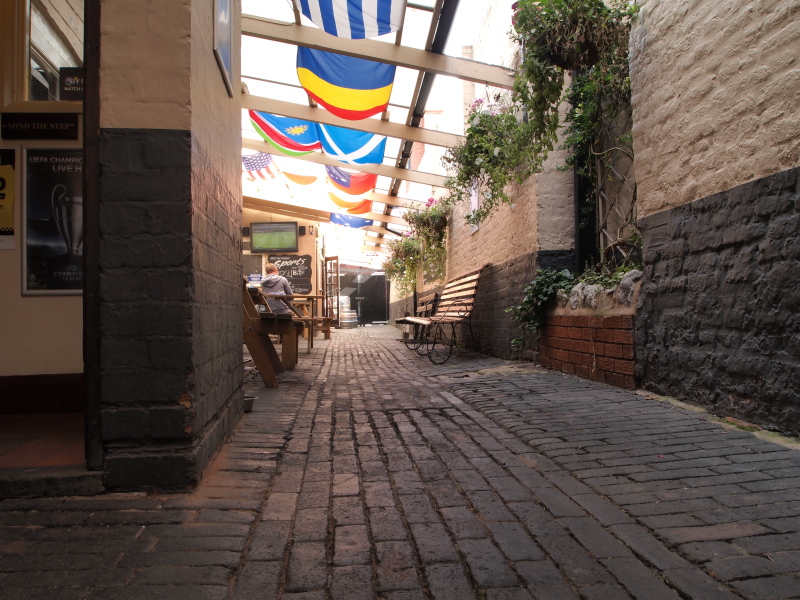
A long, covered cobble-stone yard to the right of the pub gives access to the front and rear bars, and leads eventually to the sizeable skittle alley/function room. The front bar (above) seems to be the main social and gaming hub of the Saracens Head, and this is where you'll find the pubs well-used Darts Board, with home matches played on Wednesday nights in the Worcester Darts League.


Whilst numerous alleys have been lost to pub closures and refurbishments in recent years (the Bridge Inn was in the process of closing when I visited), skittles is still popular and well supported in Worcester. The game is played at the Saracens Head in Division 1 of the Wednesday night Worcester Friendly Skittles League, and having spoken to several people involved in the game over the weekend, the alley at the Saracens Head is regarded as one of the best in the area.

The pub also plays host to a knockout competition in the summer, a time of the year when many players would prefer not to commit to league play. Invitation competitions like this offer the chance for skittlers to keep their hand in during the lengthy off-season.


Monday, 14 December 2015

General Elliott, Willoughby Waterleys, Leicestershire

I would guess that most people remember the occasion of their first pint in a pub. Often underage, probably buoyed by the company of friends, and something of a right of passage for many. For me it was a case of 'in at the deep end', a true novice amongst experienced drinkers, and a tentative introduction to what was then an alien and unfamiliar adult world.

As a boy, my only direct experience of the pub was on errands for cigarettes and chocolate, peering through the 'Off Sales' hatch of what would eventually become my local, the Black Horse in Aylestone. From there you could see the blokes propping up the bar, smoking, chatting, sinking pints. Couldn't miss the fug of stale beer and tobacco smoke. A strange and frankly uninviting environment it must be said.

I don't recall ever being taken inside a pub as a youngster, so when I started work as an apprentice at the tender age of 15, the regular work-time 'liquid lunches' in the company of adults were a new experience for me. I guess that's why that very first occasion, a long lunchtime boozing session with the men, the 3.5 tonner parked discreetly round the corner, sticks in my mind so clearly.

The General Elliott was the pub, Draught Bass the beer, and the tiny snug to the right of the front door the venue for two or three hours of solid afternoon drinking. A risky, dangerous, and quite probably sackable offence, and yet a common and regular occurrence at the time. Needless to say, I look back on those days with a mixture of horror (there was no designated driver!), and huge affection for what was probably a golden era of pub-going, the like of which we will undoubtedly never see again.


I recall visiting the General Elliott several years later as part of some cycling adventure or other. I can't remember whether the little snug still existed then, but apparently it's been gone for a good while. The pub now consists of a single L-shaped room. A snug-like area remains to the right of the entrance where the original separate room once was, the pubs traditional Skittles Table and Dart Board located at the other end. Though it's certainly changed a fair bit since my first visit, the General Elliot is still very much a traditional village local, and revitalised in the hands of enthusiastic new licensees when I visited in the summer.

A typically short entry in CAMRA's 1979 guide to Real Ale in Leicestershire & Rutland confirms the two room layout, as well as the existence of Table Skittles. The Northampton made W T Black & Son skittles table is probably in much the same location as it was back then, though whether the legs had been modified with a set of wheels as it is now, I couldn't say. It definitely didn't live in the smaller snug, and we didn't play a game back then in the early 80's.

The General Elliott currently fields two teams in the Dunton Bassett Skittles League, and a more general Games Night is held on Tuesdays.

In recent years the pub had kept somewhat limited 'rural' opening hours, but weekday lunchtime opening has now been restored by the current licensees, and an improved beer range to match. I'm pleased to say that the Draught Bass is still popular with the locals, and this lovely traditional village pub is a great destination for food, drink, maybe even a game of skittles.


Sunday, 6 December 2015

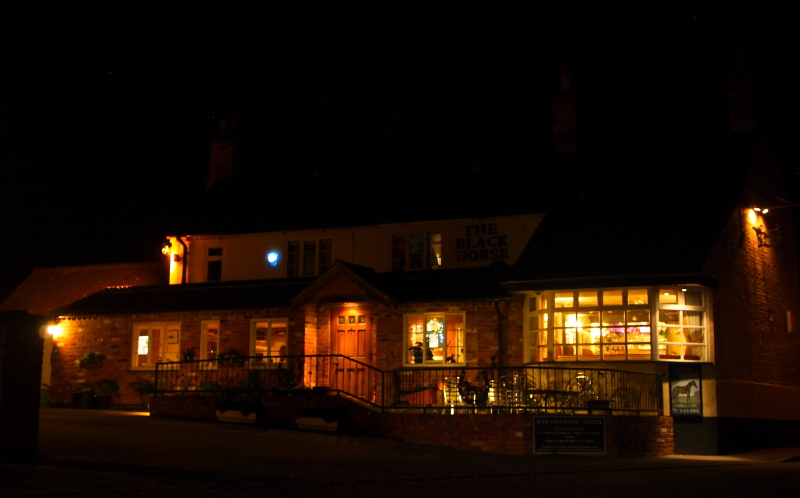
Black Horse, Caythorpe, Nottinghamshire

Anyone who's ever wasted valuable time trying to find an open pub in a rural area, with or without the aid of an up-to-date guide, will know how increasingly rare it is to find a pub of any kind in the 'sticks' these days. This is particularly true of smaller villages and hamlets with their modest local populations and minimal passing trade. Chances are that when you do find one though it will be a pretty decent pub, albeit one with more of an emphasis on food than drink these days.


In the hour or two I spent at the Black Horse in Caythorpe, passing trade seemed to be almost non-existent. The pub presumably derives some benefit from its location close to the River Trent and the nearby fishing and boating lakes, but occasional visits from walkers, boaters, and fishermen alone can't keep a pub like the Black Horse open. For that it needs the enthusiastic support of its locals, and perhaps something a bit special to attract pub enthusiasts like myself. It also helps if you can offer a beer range which is slightly different, ideally better than the one that so many tied pubs are saddled with.


Being a freehouse and offering beers from the tiny Caythorpe Brewery, located in an outbuilding at the rear of the pub, certainly helps in this regard, although the bar room staple of Draught Bass is still popular with regulars, as it is with me. The beer is very good of course, and for some, this alone might make the detour from the main road worthwhile. For me though, it's the beautifully unspoilt interior that drew me to the pub, which along with the warm welcome from the licensees is presumably a large part of the attraction for the locals too. It has also been recognised by CAMRA, featuring on their list of unspoilt heritage interiors.


The pub has been extended in more recent years, and a lobby which links the two original rooms covers much of the red brick frontage. The slightly larger main bar is to the right of the entrance (above), featuring old fixed bench seating and a bar counter in the corner with the all-important handpumps, at least one of which dispenses a beer from the in-house brewery, best bitter Dover Beck when I visited.


It's the smaller snug to the left of the entrance that most appeals to me. The word 'cosy' is of course terribly overused in descriptions of pubs, I'm as guilty of that as anyone, but this really is a place to settle in for the night with friends and a few pints. A wood burner cosies things up even further in the winter, the diminutive size of the place conducive to the age-old tradition of a chinwag over a pint or two. This room also acts as the games room of the pub, home to a Darts Board as well as all the equipment needed for the rattle of Dominoes or the shuffle of Cards. There's even a Shove Ha'penny available, though little used these days.

The Black Horse keeps fairly traditional opening hours, which means a lunchtime and evening session, not all day, and the pub is closed Mondays. It's probably best phone and check if you choose to divert this way yourself. It's also a traditional adults-only venue, so don't bring the kids!