Wednesday, 28 October 2015

Worcester Skittles


Most of the major towns in the Three Counties have a strong and enduring skittles tradition. The county town of Worcester is no exception with a fair number of alleys dotted around its pubs and clubs, particularly in the suburban areas where the pubs retain a more traditional social function than the town-centre circuit. However, the two pubs featured here represent the extremes of the games current fortunes, a situation common everywhere as pubs struggle to survive and adapt in a tough commercial world.

Although it's safe to say that skittle alleys are not as common as they once were in Worcester, the game is still popular and supported at competitive level by several leagues, including the Worcester & District Skittles League, the slightly smaller Worcester Friendly Skittles League, and a Ladies League. Players from Worcester also compete in the Three Cities League, a regional 'Derby' against teams from Gloucestershire and Herefordshire.

Throughout the traditional playing areas of the West Midlands and West Country, it's not uncommon to find skittle alleys in use most weekday evenings. Skittles is still very popular in certain parts of the country, and the consolidation that has resulted from numerous pub and club closures in recent years can make for some very busy skittle alleys. For many pubs this almost constant weekday skittles play can be the very lifeblood of the business, as the licensees of the West Midland Tavern in Worcester made clear to me on the Saturday afternoon I visited the pub.

The West Midland Tavern is located on the edge of the town centre, very much a friendly locals pub where sport, live music and entertainments pull in a good weekend crowd. During the week it's gaming that keeps the pub ticking over, and the skittle alley in particular, with teams accounting for upwards of two dozen customers on what may otherwise be a quiet night.

The West Midlands Tavern host enough teams in the various leagues to keep the alley and pub busy throughout the week. Each of the locked boxes shown below contain the pins and balls of a home team playing out of the pub, which must be quite a task for league secretaries to arrange the seasons fixture list without double-booking the alley.


You might think that leagues and teams operating in the same area would play with a standard set of  pins, but as can be seen here, there's quite a bit of variation from one set to another. These three examples could be broadly described as a Gloucester pin and two sizes of Bristol pin.


It was in conversation with the licensee of the West Midland Tavern that I learnt of the imminent demise of the nearby Bridge Inn, and by the time you read this the pub is likely to have closed, quite probably for good. A board outside advertised a 'Last Chance' disco and karaoke that evening, and what was probably a very fine pub at one time was showing all the signs of neglect I've come to recognise in similarly doomed boozers.

The skittle alley at the rear of the pub had already been taken out of service some years ago. A sad sight, made all the more so by the vintage roll of honour hanging at the business end of the alley (below), recording the early 80's Bridge Inn House Champions in Cribbage, Darts, Dominoes, Pool, and of course Skittles. The alley has been marking time as a storage and band rehearsal space for several years now, and is apparently destined to be demolished for flats. I'm glad I popped in to record its passing, and hope the roll of honour finds a better home than in a skip. Many more closures like this and the West Midland Tavern will need another alley!


Saturday, 17 October 2015

Boat Inn, Stoke Bruerne, Northamptonshire


Some of the early local and regional CAMRA pub guides can be useful documents to pub enthusiasts like myself. Dating from the 1970's onwards, these pocket-size guides would eventually cover most parts of the country, and at their best give a valuable insight into a tradition of pub-going which most pubs can only dream of now!

The actual pub descriptions are often perfunctory at best, the campaigning focus of CAMRA in those days being firmly rooted in the revival of real ale at a time when pubs were largely taken for granted! The Northamptonshire guide which I find most useful dates from the late 80's, a time which might now be regarded as the very beginnings of the current massive decline in pubs and pub going. This comparatively recent guide has much better descriptions than most, even the local Northamptonshire Skittles game was deemed important enough to feature wherever a table existed, sadly not always the case with CAMRA's current (and otherwise excellent) national pub guide Whatpub.

Though closures were much rarer back then, the late 80's and 90's were still a time of great change in the pub trade. The wholesale knocking-through of multi-room pubs was a particular concern, and inappropriate refurbishment was as common then as it is today. The descriptions in the Northants guide reflect this, sometimes in ways that seem unduly harsh in retrospect. The Boat Inn is a good example of this, the extensions and additions to the historic heart of the original pub described rather cruelly in the guide as being carbuncles!


Harsh indeed given the fate of so many similarly attractive village pubs in the intervening years. The writers of that pub guide must surely reflect on whether this beautiful thatched canalside pub would have survived at all had it not been for the investment and far-sighted business sense of the owners? That the original series of interlinked rooms survive to be enjoyed today is undoubtedly thanks to the success of the business overall. A honey-pot for families and diners which fully exploits the pubs attractive location, and yet remains entirely true to its origins as a humble bargees watering hole and village local.

You really have to take your hat off to the licensees of the Boat Inn. Less sympathetic owners would no doubt have opened out and spoilt the original interior to squeeze a few more tables in, assuming it even survived as a pub. And would a space have been retained for the old Northamptonshire Skittles Table in the bar? Doubtful in my view.

The Boat has been run by the same family for approaching 150 years, and in sympathetically modernising and extending the historical original, they have surely done local and visiting pub-goers a huge service. Indeed my only criticism of the interior is that you probably have to get there pretty early to bag a seat in the cosy older part, such is the popularity of the pub at all times of the year.


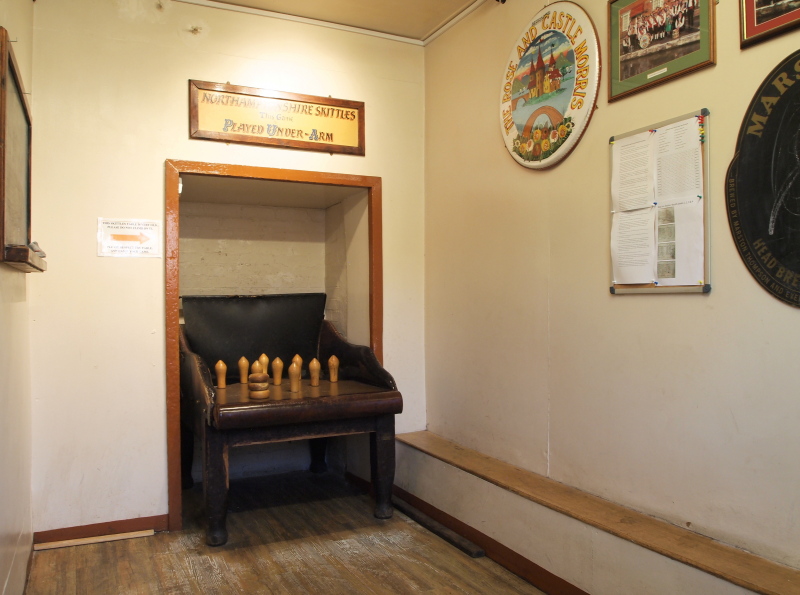
The Skittles Table, a 1960's W T Black & Son model, sits in its own ante-room off the old bar area. The table is missing the usual netted 'hood' designed to catch wayward throws, but this is not really required given that the table sits snugly in an alcove. I imagine it must come in for an awful lot of play from visitors to the pub, particularly the steady stream of leisure boaters with more time on their hands than most. Northamptonshire Table Skittles must be a local curiosity for many visitors, who no doubt require a little coaching in the throw, the rules of the game, and general skittling etiquette.


Life has just got a little bit tougher for this venerable old table following the Boat's recent return to the Gayton & District League after an absence of over 25 years.


Several decades of use can take its toll on a Northants Skittles Table. The leatherwork is usually the first thing to go, the woodwork usually requiring little more than a new coat of paint. Table No.124 has been refurbished by A Pinkard of Kislingbury at some point in the past, a name which appears on many skittles tables in Northamptonshire, and probably the local repairer and refurbisher for most of the league tables in the Gayton League.

Saturday, 10 October 2015

The Loggerheads, Shrewsbury

If you only have time to visit one pub in Shrewsbury, my recommendation would be the fabulously unspoilt Loggerheads on Church Street. Located in the very centre of the town, this is surely every tourists idea of the quintessential English pub. A truly historic and unspoilt alehouse, important enough to be included on CAMRA's inventory of Historic Pub Interiors.

There's absolutely no doubting the heritage of the place. It's all there waiting to be seen because thankfully the current owners have resisted the urge to enhance or embellish its natural charms unnecessarily. Beautifully well-maintained, it's also an honest, working, town-centre locals pub, and that is perhaps the most remarkable aspect of the Loggerheads.


This aspect is perhaps most clearly seen in the small Bar Parlour (above & left), the centrepiece of the pub which fronts the main servery and it's row of polished handpumps.

Quiet and intimate, the kind of place where it's hard not to be drawn into the conversation, indeed it would probably be rude not to. This is clearly the social hub of a friendly and welcoming town-centre pub. Would that all pubs retained a 'Bar Parlour' like this.


There are two entrances to the pub, one takes you down a corridor to a smaller servery, opposite which is the Smoke Room (below). This was a 'Gentleman Only' bolt-hole until as recently as 1975. High backed settles and rough scrubbed-top tables create an intimate space, ideal for an afternoon game of Shove Ha'penny. The pub has a fine old slate board in the 'Smoke', and half pennies are available for a game from the bar.

 
The other entrance leads directly into the 1930's refurbished Lounge Bar (below), which if it were not for the rest of the Loggerheads attractions would be worth the admission price on its own. Note the erroneous Loggerhead Turtle pub sign mounted above the servery. As can be seen below, this room houses the pubs Dart Board.
 

Sunday, 4 October 2015

The Crown, Bathley, Nottinghamshire


The Crown first came to my attention a few years ago following a visit to the Muskham Ferry at nearby North Muskham. The Newark area was, until quite recently, one of only a handful of places in the country where Table Skittles, or Devil Amongst The Tailors, was still played competitively at league level. Sadly the league folded several years ago, but occasional friendlies are still played in those pubs where the skittles table hasn't been packed away for good. The locals at the Muskham Ferry were just about to play one of these friendlies, an away match at the Crown.

I can certainly see the appeal of an evening friendly at the Crown, it really is a great all-round village local. A pub noted for good beer and food in an attractive rural location, and with a lovely garden for the summer months. The lounge bar with its open fire a comfortable retreat in the winter, and a smaller public bar which houses the pubs well-used Darts Board. It's also the principal venue for village functions, and the meeting place for local council business given that the village has no other suitable venue.


The Skittles Table may only see occasional friendly use now, but the alley where it resides is still in regular use for games in the Newark & District Long Alley Skittles League. Long Alley in the Newark area is played with the same iron-shod curvy pins and large round balls found throughout Nottinghamshire, and as far north and west as Clay Cross and Ashbourne in Derbyshire. This is a very well-appointed alley in an area where many are still located outdoors and largely exposed to the elements. The cast iron 'frame' is set a little smaller than many, which means the pins stand slightly closer together resulting in higher than average scores.


Most of the skittles tables I've seen in the Newark area are locally made, usually by a pub regular or someone known to the league. These tables often bear a small brass plaque with the name of the maker, and perhaps uniquely to the Newark area, feature a small drawer rather than the usual lidded trough to store the pins in. The one at the Crown however seems to be a good quality manufactured table, similar to the better quality old Jaques models where a crib-style scoreboard acts as a cover for the skittle storage trough. The dimensions and spacings are standard though, as they would have to be to facilitate league play.

In the games heyday of the early 20th century, these 'league standard' skittles tables were made by numerous small manufacturers throughout the country. Some were very high quality indeed, sturdily manufactured from mahogany or other expensive hardwoods, and with leather padding to reduce impacts and noise during a game. This table is more modestly upholstered, as most pub tables are, with a few offcuts of carpet. The skittles table can be brought into the bar for a game on request.


Friday, 25 September 2015

Bulls Head, Cosby, Leicestershire

The south Leicestershire village of Cosby was little more than half an hours walk for me when I lived in nearby Littlethorpe. At that time there were three decent pubs in the village centre, the Blacksmiths Arms, Huntsman, and Bulls Head, and I made the walk to Cosby quite often as a result. Today the village is down to just one pub and the Working Mens Club.

Despite strong opposition from locals and villagers the Huntsman is now a Co-op store, and the Blacksmiths has been an Indian restaurant for several years now. The one remaining pub in the village, the Bulls Head, is an Everards Brewery house, and thankfully for those locals still interested in such things, a very good one at that.

Everards continue to support pubs like the Bulls Head where others (such as serial pub-closers Marston's, the previous owners of the Huntsman) show little or no such commitment. They also have a good track record when it comes to maintaining their pub estate, and even if the current 'vintage' makeovers, which are being rolled-out across the estate, might not be to everyone's taste (it works very well at the Bulls Head), their pubs remain attractive and inviting as a result.


Just as importantly in the context of this blog, Everards are also custodians of more traditional Skittle Alleys in the Leicestershire area than any other brewer or pubco. This part of South Leicestershire, close as it is to Everards Castle Acres brewery site, is one of the hotbeds of Long Alley Skittles play, with Everards pubs in Broughton Astley, Croft, Enderby, Huncote, Littlethorpe, and Whetstone all boasting good indoor skittle alleys.

The alley at the Bulls Head would probably have been a separate building at one time, though now accessed directly from a central corridor of the pub. I think this is why the throwing end of this, and other similar alleys, are laid with deep transverse lines around the foot hole or 'Mott' (below). Winter journeys from bar to skittle alley meant that players shoes would often be wet, and these grooves would have provided a non-slip surface as players launched themselves down the alley.


A modern conservatory at the rear of the pub houses the Skittles Table, set here with plastic 'Northamptonshire' style pins, but this is actually a Leicester Skittles Table. The Leicester variant of the game is very similar to the more common 'Northants' version, but uses thinner pins shaped like miniature Long Alley skittles. The cheeses are proportionately smaller and usually made from a very dense hardwood such as Laburnum or Lignum Vitae, though I've also seen plastic examples.

Tables like this are the norm in  and around Leicester city, but can also be found in an area broadly defined as South-West Leicestershire, as well as the Soar Valley area of North Leicestershire. This seems to coincide with those areas which have the strongest remaining Long Alley tradition, perhaps suggesting that this version arose as a Winter alternative to the alley game, somewhat independent of the similar Northamptonshire game.

To complete the picture of this excellent village local, Darts is very popular, as evidenced by the number of trophies littering the bar, including the impressive Ladies Knockout Cup shown below. The Bulls Head was also an early-adopter of the food franchise concept, with the popular Winley's Chinese Restaurant operating successfully from a separate room at the pub.

Saturday, 19 September 2015

Prince of Wales, Shrewsbury

How best to describe the Prince of Wales. The pubs own website suggests 'Hidden Gem', which seems entirely legitimate to me. It might even be described as Shrewsburys best kept pub secret, certainly it's a little off the beaten track, though we found it easily enough. Indeed the landlady of the B&B we were staying in seemed reticent recommending the Prince of Wales to us, something to do with it being her local!

It can be like that with a well-loved locals pub, the last thing the regulars want is an influx of tourists and part time pub-goers clogging up the normal, efficient day-to-day service. But as we know, pubs need all the trade they can get these days, so I have absolutely no qualms in recommending this very fine pub to you, and urge you to seek it out the next time you visit Shrewsbury. Local Shrewsbury folk need no such urging, they've already found it, they're just not saying!

The view from the lounge to the Patio and Bowling Green
From the outside the pub presents itself as a fairly typical wide-fronted community local of a type which came to prominence in the inter-war years. These so-called 'improved' pubs were designed to replace some of the more 'earthy' Victorian and earlier boozers, and appeal to a wider range of tastes and social backgrounds. A feature of many was the inclusion of recreational facilities not primarily associated with drinking, and this period marked the beginnings of the dedicated beer garden proper. The wide frontage of the Prince of Wales gives a clue to the pubs star attraction. Not a beer garden but a full-size Crown Green Bowling Green which sees very regular use throughout the summer months.

If you've yet to witness a Crown Green Bowls match in progress this is probably the ideal place to see what all the fuss and noise is about (it's a far noisier game than its Flat Green relative). A raised patio overlooks the green, and there's plenty of 'stadium' style seating bordering the green for spectators (some rescued from the old Shrewsbury Town Football Club ground). It really is the perfect accompaniment to a cool pint on a warm summer evening.


Inside and to the left of the entrance is the public bar (above), home to the Darts Board and several raised-edge games tables suitable for the rattle and click of league Domino play. Dominoes is still very popular in Shropshire and the local Shrewsbury Domino League seems to be well supported in the more traditional pubs of the town.

A central bar serves both the bar and lounge. Originally a Border Breweries pub, the Prince of Wales is now free of tie, and when we visited the beer range included excellent local ales from Salopian and Three Tuns breweries. The pub is the current (2015) Shrewsbury CAMRA Pub of the Year.


The sharpening stone, grooves worn deep from many years of restoring a sharp point to Darts.

Friday, 11 September 2015

The Herdsman, Hereford

Occupying a substantial corner plot on the outside-edge of Herefords busy ring road, the solid three-story 'block' of The Herdsman is hard to miss. Yet when I popped in for a pint on a hot summer day last year, not only was it my first visit, in all honesty it was the first time I'd even noticed this imposing, unmissable pub!

Certainly it had been a few years since my last trip to Hereford, but I'm no stranger to the attractions of the town, particularly those centred around the county's most famous export, fine traditional cider. The fact is, the Herdsman simply wouldn't have registered on my finely-tuned beer and cider radar in those days. Little has changed in this regard, and on the occasion of this visit I made do with a perfectly acceptable Guinness, though I'm reliably informed that a real ale has been introduced since then.


The real attraction of the Herdsman may not be obvious from a casual inspection of the bar, although the neat row of polished trophies lining the bar-back should give a clue. This is a pub for the games and sport enthusiast first and foremost, beer merely the lubricant to competition, not the main attraction. This is no 'Sports Bar' though. The Herdsman is home to the more traditional, though no less competitive pastimes of traditional pub gaming, and in this regard the pub is truly unmissable.

It's in the hallway to the rear of the bar that you'll find confirmation of this on the all-important noticeboard, crammed as it is with fixture lists for the many teams which play out of the pub. Cribbage, Darts, Skittles, and the local game of Quoits all feature. There can barely be a night when there isn't something going on at the Herdsman, live televised sport filling the gaps along with numerous functions and charitable fund raising events. Even the local Chess Club meet at the Herdsman.

This is a true community local of a type which is getting scarcer by the day. I found the Herdsman a friendly and welcoming pub too, and I'll certainly be returning for a pint the next time I'm in town.


There are two of the traditionally painted concrete Quoits Boards at the Herdsman, one in the small Pool room (below), the other in the large function room at the rear of the pub (shown above). All Hereford Quoits Boards sit on specially fabricated steel frames similar to that shown above, netted to prevent too many wayward Quoits landing on the floor. I use my Quoits Board without one of these, and know how much of a pain it is having to retrieve the floppy rubber Quoits from wherever they might have landed, or subsequently rolled off to. I really must get one myself! The rubber Quoits used in this game are difficult to source and surprisingly expensive to replace, so not usually on show with the boards. A set should be available from the bar for a casual game outside of league nights though.

There are Mens and Ladies Quoits Leagues in Hereford, and the Herdsman field teams in both. In fact the Herdsman seems to be the HQ for league Quoits play in the city.


The function room at the rear of the pub is also equipped with several Darts Boards for play in the various local leagues, and two well-used Skittle Alleys. The Herdsman is perhaps unique in being the only pub in the town with three good alleys, a further one being located upstairs, though some Hereford club venues have multiple alleys too.

The Hereford & District Invitation Skittles League was formed in 1902, and is still going strong in the area with 66 teams competing in 7 leagues. Four teams share the alleys at the Herdsman, and the best night to catch a game is probably Friday.