Friday, 22 May 2020

Adam & Eve, Cheltenham


As I write this post, pubs everywhere have been forced to shut up shop in the wake of the global Coronavirus pandemic. That some of these pubs may struggle to re-open again seems a very real possibility at this time, which is of course small-beer when set against the bigger picture of loss of life, and the potential collapse of our precious health service. It is however, sadly ironic that the social distancing required to tackle the spread of this virus, can itself affect our health in less obvious ways. Because for most of us, human contact and the kind of socialising that's at the very heart of pub-going, isn't an optional extra to a healthy and happy life, it's essential to our mental wellbeing.

All pubs fulfil this vital social role to some degree. For many of us, if we didn't already know it, this sudden absence in our social lives will have highlighted the true value of pubs, a value that goes beyond their role as mere purveyors of alcoholic drinks.

Whilst drinking the very best beers, wines, and ciders at home remains an epicurean pleasure that's thankfully still open to most of us, for me, and many pub-goers like me, this represents just a fraction of the pleasure derived from spending time at the pub in good company. Perhaps this awful and utterly depressing health crisis will be the thing that finally opens peoples eyes to how special pubs can be, and the important place they still occupy in our increasingly fractured society.

The Adam & Eve

What would turn out to be my last proper weekend away before lockdown was a trip to Gloucestershire in late March, and even this was touch-and-go given that it was during the latter stages of yet another devastating Severn flood. As it was, Tewkesbury was damp, but very much open for business, and I'm so glad that I went even though some of the pubs I was aiming to visit were closed due to the flooding. I finished the weekend with a short Sunday stopover in Cheltenham, the town braced for a deluge of its own given that this was the weekend before race week...

Now I've got into the slightly lazy habit of heading straight to the Bath Road when in Cheltenham. The new-ish Bath Road Beers bottle shop/micropub has lately become the go-to venue for more 'modern' styles of beer in Cheltenham, and as such it's been a while since I've visited anywhere new, different, or indeed any of my old favourites. This time I fancied a change, and with the benefit of hindsight I'm very glad that I did.
I like to think I know my way around most of Cheltenham pubs, but the fact is there are still plenty that I've never been to, including a good few that represent the towns longstanding skittles tradition. I had a couple of pubs in mind that day, including a large estate pub in the leafy post-war suburbs that would have to wait for a less rainy day.

The Adam & Eve is just a short walk from the town centre in an area I've never properly explored. Quite why or how I've managed to miss the Adam & Eve all these years is a bit of a mystery though. It's such a well-loved pub locally, a former Good Beer Guide regular that nobody I know has a bad word for, even though it seems to have fallen off the beer enthusiasts radar in recent years. This is an Arkells Brewery pub, so you'll find no murky craft beers or cutting-edge imported hop-monsters here. Just a solid, traditional, locally special backstreet boozer, serving the local beers its loyal locals want.

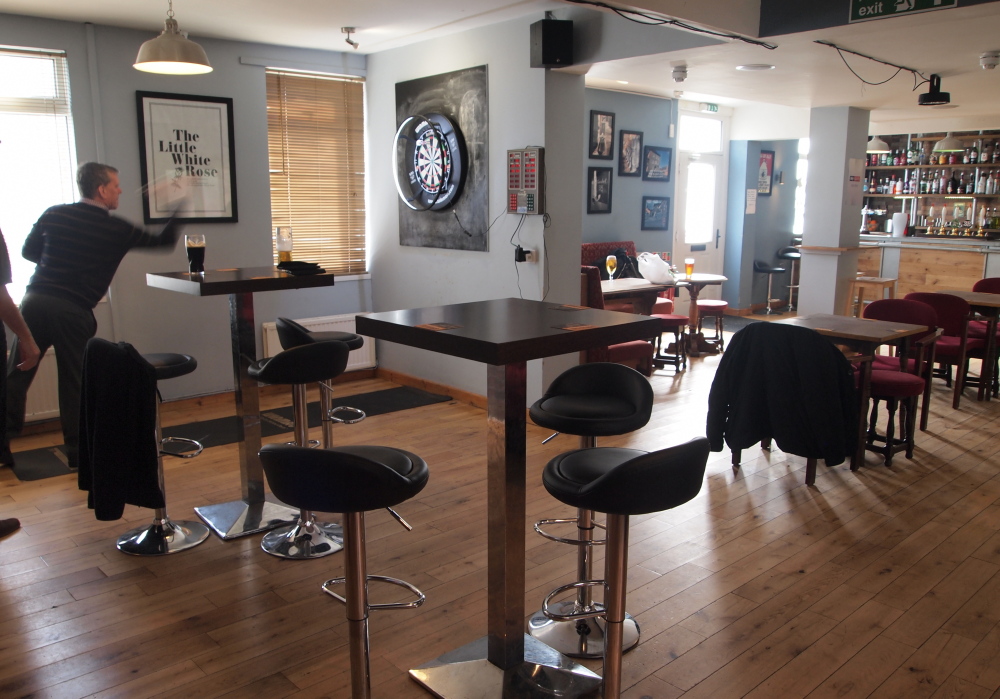
It's likely that pubs like the Adam & Eve will be missed more than most by their locals during this crisis. When I popped in at the crack of opening time on Sunday, I don't think I could have got through the door any earlier, and yet a scattering of locals were already settling in for the afternoon. A couple of chaps methodically working their way through a game at the Dartboard. A smartly dressed elderly couple occupying a prime position near the door, all the better to greet friends and acquaintances as they arrived, myself included. A handful of bar flies of course, chewing the fat with the gaffer over the first pint of the day. And half a dozen regulars grouped around a table on the edge of the Skittle Alley, the unmistakable banter of a serious card game that looked like it would go on for most of the afternoon. I had a pint of something good from the local brewery, I don't recall what it was. Watching the timeless workings of a solid traditional locals pub on that most traditional of all pub sessions is thirsty work after all.

The Adam & Eve is one of perhaps a dozen or so venues in Cheltenham for Skittles. The alley located slap-bang in the middle of the pub, which must dominate proceedings when a noisy match is progress. The pub hasn't always had this slightly unusual layout. The story goes that the pub was originally just the left-hand side of the current building, the alley running down the right-hand wall and projecting out to the rear of the building. Needless to say this was something of a noise issue for their immediate neighbours, so when the chance arose the brewery bought the property to the right of the pub and knocked through. At a stroke doubling the size of the pub, putting the alley in the centre of the resulting space and no longer adjoining a residential property. That's real dedication to Skittling! Or perhaps an acknowledgment by the brewery of the serious trade that Skittles brings to pubs like the Adam & Eve.

When this lockdown ends, and pubs are finally allowed to re-open, I doubt whether the locals of the Adam & Eve will have gotten so used to drinking at home that they won't be rushing back to the pub for the Sunday session. Proper locals pubs like the Adam & Eve are social-centres first and foremost, and represent what pubgoing is all about in my view. When this lockdown ends, it's pubs like the Adam & Eve that I'll be rushing back to.


Thursday, 7 May 2020

Greasley Castle, Eastwood, Nottinghamshire


This was originally going to be a 'before-and-after' post on the Greasley Castle. As it stand it's merely the 'before' that you see here, the 'after' will have to wait until the travel restrictions we're all labouring under are lifted and I can finally return to Eastwood. These photographs were taken almost a year ago as part of an exploration of pubs in the Eastwood area, taking advantage of travel on the Trent Barton Rainbow 1 bus route on a rainy midweek afternoon. There's a lot to explore on this popular route because the whole area is very well pubbed, many of which are very good pubs indeed. Needless to say I didn't manage even the half of it that day, and have been looking for an opportunity to revisit the area ever since...


The Greasley Castle pub is itself unfinished business for me. When I popped in for a pint and a chat with the landlord that day it was clear that things were about to change at the pub, and change for the better I was assured. So the pub that you see here, whilst certainly attractive and traditional enough (certainly for my tastes), was perhaps not showing at its best after several years in the hands of a locally unpopular national pubco. In an area that's now regarded as something of a beery destination by those in the know, literally awash with new-ish micropubs as well as some very highly regarded traditional older boozers, the Greasley Castle had perhaps fallen behind some of the local competition. Enter Derbyshire pub chain the Pub People Co, who have good form revitalising pubs like this in the Derby and Notts area. As it happens, the pub was due to close for a welcome refurbishment within days of my visit.

The Greasley Castle is one of many Hardys & Hansons pubs in the area that subsequently passed into the hands of Greene King following the unfortunate family sell-out. The painting below, which hopefully still hangs on the wall of the bar, shows the pub in its former 'Kimberley Ales' livery, a common sight throughout the area given Eastwoods close proximity to the now closed brewery. This was 'Kimberley Country' back then, and the traditional dark Mild and refreshing Bitter were popular with local drinkers in a way that some of the replacements from Bury St Edmunds don't seem to be, which probably explains why the Greasley Castle has always served local guest beers, including longstanding Derby and Midlands favourite Draught Bass.

What was probably a multi-room pub in its original guise has been opened out over the years to form a single room, albeit retaining three distinct areas. The larger bar area is clearly the social hub of the pub, the place to prop up the bar and chew the fat over a pint, but there's also a cosy lounge/snug to the rear (above), and a smaller tile-floored area that was home to the pubs Dartboard when I visited. Televised sport is clearly very important at a pub like the Greasley Castle, but so too are traditional pub games, as evidenced by the shelf-full of plaques and trophies for that most traditional of pub games, Dominoes.

It's not at all clear at this time whether the Wednesday 5' & 3's Domino session is still going strong at the pub, or indeed whether the Darts throw has survived this most recent refurbishment. All of which I'm keen to discover on a future visit whenever that might be. One other thing I'm particularly keen to explore is the newly spruced-up patio to the rear of the pub, because the Greasley Castle, in common with many community locals in this neck of the woods, was once a pub for the local Nottinghamshire and Derbyshire game of Long Alley Skittles. The pubs outdoor skittle alley was certainly still in situ at the time of my visit, though sadly not in any state to be viewed or photographed. It may still be there underneath the garden furniture, so I'm keen to record its existence even if it may never see action in a game of skittles again.


Monday, 13 April 2020

Northway Arms, Northway, Tewkesbury, Gloucestershire

Classic 'modern' estate pubs like the Northway Arms don't as a rule feature heavily on beer blogs, and with one or two notable exceptions, rarely make much of an impression on pub blogs either. Indeed why would they! These pubs are neither fish nor fowl in the world of blogging, more often than not tied to a very limited beer range, and not usually regarded as being historically or architecturally important. It's one of the reasons I'm keen to feature them on this blog, because they really are a neglected subject both online and in print such that it can be quite difficult to research their origins or near past. Another reason being that we've lost so many of these boozers in recent years, often leaving little or no trace that they ever existed.

In many ways, those post-war and early 20th century estate pubs that do survive (as well as trades and social clubs) represent a last link to how all community locals would have been at one time, and how many still were in the mid-80's when I first started drinking in them. Pubs that served a multitude of social functions for a largely local clientele, and where the range of beers, whilst it may have had some bearing on which pubs you and your mates preferred, played second fiddle to who you were meeting up with that night, or what gaming and entertainment might be on. As the only pub on quite a large estate that's neither bustling town nor rural village destination, the Northway Arms simply has to fulfil this varied and inclusive social function if it's to thrive.

Of course estate pubs have always had a limited appeal to the beer enthusiast. Particularly given that many were established during the infamous rush to keg of the 1960's, and were probably regarded as unsuitable outlets for the nascent real ale revival that followed in its wake. The Northway certainly had a cask beer from the Allied stable of breweries in the mid 90's, and may well have done when the pub first opened its doors in the 60's or 70's, but sadly the handpumps are now long gone.

It's also true that many estate pubs are regarded (often by those who don't actually use them!) as being slightly less than attractive as social venues. There's some truth in this of course. Until relatively recently, estate pubs have been largely ignored by their pubco owners when it comes to the annual refurbishment budget, the spending more often targeted at high-earning food outlets, city-centre bars, and rural tourist destinations. As a result many of these buildings have been in steady decline almost since the day they were built. Never particularly attractive to non-locals anyway, but getting ever more tired and unloved over the years until the axe finally falls on what were once very popular pubs that even the locals have fallen out of love with. Neighbourhood supermarkets in residential areas mark the passing of many of these sadly neglected boozers.


Over the last couple of years though I've noticed welcome signs of change, and visited several recently refurbished estate pubs that are finally being given a second chance by their owners in the hope of re-establishing them at the heart of the communities they serve. The Northway falls very-much into this category. The pub has received a comprehensive makeover in recent years that fully respects the buildings historic origins as a Manor House in the original Northway hamlet. It's immaculate inside and out, retains a multi-room layout, and is a credit to the current licensees who've been very proactive with regard to functions, events, and charitable fundraising within the local community throughout the last 7 years of their tenancy.


Whilst the Northway is undoubtedly a very fine pub in my view, it's not, if I'm absolutely honest, a pub I'd be going out of my way to drink in under normal circumstances. I think it's safe to say that this is very much a local pub, primarily serving the needs of locals on the Northway estate. Not so much a destination pub for a tourist on his way back from a long day out in Worcester, though the fact that the pub also functions as a handy waiting room for the Ashchurch rail station goes some way to explaining why I found myself in the bar, Guinness in hand, late on a Saturday night. Now I'd certainly had a few beers that day, but then so it seems had the locals. A lively but friendly bunch as you'd expect on a Saturday night. The banter was a little bit coarse it's true, you either like that or you don't. I'm fine with it and I think they were fine with me as a result.


Of course the main reason I was happy to pop in for a pint was that the Northway is an important venue in the local Tewkesbury & District Skittles League, and I have to thank the barman who was on that night for happily opening up the skittle alley for me when I'm sure he had far better things to do.

Gloucestershire remains a stronghold for the 'West Country' skittles tradition, with leagues centred on most of the bigger towns, albeit that the Tewkesbury League is certainly not what it was. Whilst the league seems to be well supported, currently stretching to four divisions of over fifty teams, venues continue to be lost. This years devastating floods in the Severn region seem to have finally done for the White Bear in Tewkesbury itself, the licensees finally throwing in the towel after several years of repeated and highly damaging flooding (though I have heard rumours of a possible reprise since I visited). The pub was up for sale when I popped down for a look, it's future very far from certain, and of course this includes its very fine skittle alley, the last remaining alley at a pub in Tewkesbury itself.

Which makes surviving pubs like the Northway all the more precious. Because classic estate pubs are not only a last link to what some of us regard as a golden age of social pub-going, but often they're the last custodians of a social gaming tradition every bit as important as beer and brewing, the subject of which seems to dominate the pub scene now to a wholly disproportionate degree in my view.

As I write this, the Northway Arms is of course closed along with all other pubs during the current national lockdown. The pub is still serving the community however, acting as a collection point for food and other important supplies, helping provide a lifeline for self-isolating individuals and other vulnerable people within the Northway area.

A practice set of skittles is always available for a few 'hands' at the pub, with each teams matchday pins kept secure in boxes as shown (above). The partition to the right of the pins (below) is where the 'sticker' takes refuge after re-seating the pins.

Sunday, 29 March 2020

London Inn, Charlton Kings, Cheltenham, Gloucestershire

It's been a few years since I visited Cheltenham and surrounds for a weekend of pleasure and pints. Needless to say the pub scene has moved on a bit since then, but only a 'bit' so far as I can tell. Yes, there's a smart new craft beer bar and bottle shop on the funky Bath Road, and a similarly shiny new Brewery Tap near the rail station, but the town has already seen a craft beer bar fail, and the burgeoning micropub phenomena seems to have passed Cheltenham by up to now. Not necessarily a bad thing in my view given that micropubs are often the natural replacement for struggling traditional boozers rather than a welcome supplement to them. All this might suggest that Cheltenhams pubs are struggling that little bit less than most, and this may well be true. We've all been to pubs that by luck or design seem to have sidestepped the general decline in pub-going. Cheltenhams pubs seem to me to be as popular as ever with a loyal local crowd.


What has continued to change though is the steady, seemingly inexorable loss of the towns more traditional pubs, and often with it their traditional skittle alleys. Sometimes the result of a pub closing, more often though it's down to the creeping gentrification of the pub market that's happening almost everywhere, and the ever-present trend of chasing the (already saturated it seems to me!) food trade.

This is a longstanding trend of course, and one that I've noted many times before on this blog. The Brown Jug on Bath Road is a good case in point. When I visited some five years ago it had only just been refurbished, but the excellent skittle alley remained a firm fixture and the pub was very busy throughout the week with league and cup matches. Recently though, I discovered that the pub has been refurbished once again, this time the skittle alley converted to yet more dining space. A truly inexplicable loss of what was clearly a very well-used asset, and just the latest in a long line of similar losses.

Where once it was common for pubs throughout the town to have a skittle alley (sometimes more than one), with home 'A' and 'B' teams in both Mens and Ladies leagues, there are now just a fraction of the alleys available (albeit for a reduced number of teams). This has resulted in ever-more skittles teams being squeezed into a dwindling number of pubs and clubs. Hence there's often a log-jam of matches throughout the week, and a bit of a nightmare for those compiling the fixture lists. Now that the alley at the Brown Jug has gone, another half-dozen or so teams are either looking for a new home or will sadly, almost inevitably, call it a day. This of course, is how pub games eventually die...


So pubs continue to close or move upmarket, and alleys continue to disappear, but there's still plenty of interest in the game from locals of all ages, and plenty of teams still keen to play during the week. The Cheltenham Skittles League alone comprises over a dozen divisions for Mens and Ladies competition, added to which are several teams playing in Summer and Winter competition in the Cheltenham Civil Service Skittles League. But the fact remains, the number of alleys available, and the lack of commitment to the game shown by some local pub owners really doesn't reflect the demand that's still there from locals, which means the Cheltenham skittles tradition is becoming a less common, more specialist aspect of the pub scene. It's also being pushed ever further from the upmarket centre of town.

This shift of skittles to the suburbs and villages is sad and perhaps inevitable, but it's also clearly to the benefit of pubs like the London Inn which now hosts several teams, including of course some of those which have been exiled from their own 'home' alleys. Even so, chatting with the licensee of the London Inn confirmed that pubs in the Charlton Kings area have experienced a similar level of closure and gentrification to that seen in Cheltenham and elsewhere. Of the nine pubs listed in my 1990's copy of CAMRA's Real Ale In Gloucestershire, only a couple have actually closed, but of the four which are listed as skittles pubs, only one now remains. The Little Owl closed some years ago, and both the Merry Fellow and Royal appear to have removed their alleys in favour of the all-important food trade.


Of course dining is an increasingly important aspect of the London Inn's success, but thankfully it represents just one part of the pubs wide appeal. The current licensees have been at the pub for just a few short years, but have already made a terrific job refurbishing and revitalising what was a typically tired and neglected village local. The pub is now a proper all-rounder with a tidy beer garden to the rear, all the televised sport in the bar, and a quality food offering that's attracting visitors to the pub. It's also a proper Inn, with several recently refurbished letting rooms available.

I popped in early-doors Sunday for a pint whilst the staff were gearing up for the traditional Sunday Lunch trade. A scattering of locals were in for that other Sunday afternoon tradition, the televised football, and as Sunday traditions go, few are more welcome than the huge bowls of roast potatoes that appeared on the bar as I was mooching around with my camera. The skittle alley, which extends into the garden, is in use most weekday evenings for league matches, and in common with most of the alleys in this neck of the woods, it's smart and impeccably maintained. It certainly needs to be as this space also doubles as the pubs equally important function room.


Friday, 13 March 2020

The Old Crown, Wigston, Leicestershire


I've had a run of bad luck when out and about with the camera recently, arriving at several pubs with high hopes of great gaming interest, only to come away with nothing but the lingering taste of a slightly rushed pint. Partly it's down to it being that fallow time of year, the gap between Winter and Summer league activity when the pub games have been tidied away. In other cases it's simply that the numerous online resources I rely on for accurate information have not been adequately updated, or at least the all-important gaming aspect has been overlooked yet again.

I've also come unstuck on a couple of occasions with that perennial bane of the pub-goers life, the opening hours lottery. Not such a big deal in a town with plenty of alternatives, but a village pub that isn't open when advertised can be a bit of a disaster, particularly if you're using public transport to get there. Less troublesome, though no-less frustrating from my own perspective, is when a pub turns out to be a bit dull, and just not interesting enough to inspire a blog post. A restaurant in all but name with a skittles table shoved away in a corner out of sight, hardly makes a good subject on a blog dedicated to tradition and the pub as 'local'.


The day was heading that way for all these reasons and more on a recent exploration of the 'skittles zone' south of Leicester, such that I was on the verge of giving it up as a bad job and retiring to the local micropub (little gaming interest, but a guarantee of good beer at least). I decided to try one more pub on the way though, in the hope of third time lucky!...

The Old Crown Inn was already a failed visit from several years ago. On that occasion I'd arrived when the pub was open and buzzing with local life, definitely good material for this blog, but sadly the Skittle Alley I was keen to record was "...a bit of a mess at the moment, the season's over you see...". A great shame as the pub itself is one of the most traditional and relatively unspoilt in Wigston, a proper bar and lounge affair with beamed ceilings and décor just the right side of lived-in/scruffy for my taste. I liked the place. A proper village boozer of the kind I generally prefer to spend my drinking time in, so I aimed to return when the skittle alley was up and running, but obviously never quite got round to it.


So after an afternoon of disappointments, three cheers for the Crown. Not only open, warm and inviting, and with a decent Saturday afternoon crowd in the lounge, but a good pint too and newish licensees who were happy to show me the skittle alley I'd missed on my last short visit. A major change is the interior, the slightly shabby but pleasant one I'd admired first time around clearly hadn't passed muster with the pubs owners. The lounge in particular has been spruced-up, refurbished for the more discerning customer I guess, though certainly not overdone or spoilt as so many have been in recent years. So still a traditional two-roomer, and still very much a pub for the locals who regard the Crown as an escape from the more lively pubs in the village.

The local history society have suggested that the Old Crown is one of the oldest buildings in Wigston, built perhaps a hundred years before it gets its first mention in an 1846 edition of Whites Directory. There are numerous outbuildings to the rear, all contemporary with the main building, but the Skittle Alley is probably later. Though a relatively 'modern' addition, the skittle alley surface shows enough ware and tear from decades of enthusiastic use to give the impression it could be at least as historic as the pub itself.


Long Alley Skittles probably developed as an outdoor game in the East Midlands, indeed it remains so at many pubs in Derbyshire and Nottinghamshire, albeit that more and more alleys are being covered over or enclosed to some degree. All the pub and club skittle alleys that I'm aware of in Leicestershire are located in adapted or purpose built buildings, but the twin alleys on the village green at Thrussington in the north of the county couldn't be more outdoors, and perhaps gives us an insight into what may have been more common in the early days of the game.

Long Alley is of course a highly skilful game in the hands of experienced players. Nevertheless it represents the most basic form of all the surviving skittles games. For most of its length the 'alley' merely serves to define the distance of the throw, since the 'Cheeses' used in Long Alley are not rolled down the surface, rather they're tossed through the air. So the game can be played just about anywhere so long as there's a hard-standing area for the tall wooden pins, and a clear throw of an appropriate distance.

Long Alley has changed very little over the years, and retains much of the feel of an ad-hoc game played with relatively inexpensive equipment, and in whatever yard or outbuilding was available at or near where beer was drunk. The mottled flooring around the 'chock hole' (above) for example, is a common feature of Leicestershire skittle alleys, most of which are located in separate buildings to the main pub. When delivering a cheese down the alley, the trailing foot must remain in the chock hole until the cheese is released, but this does not preclude launching yourself down the alley immediately afterwards if that helps deliver more speed or accuracy to the throw. Of course frequent trips to the bar on wet evenings could make a smoother surface dangerously slippery, hence this mottled non-slip flooring around the chock hole.


Skittles in Wigston and the wider area of south Leicestershire is played in the Tom Bishop League. The recently concluded Winter League has two divisions, the Premier Division sponsored by local brewers Everards, maintaining a tradition which stretches back many years and was the standard for pub games leagues when most pubs were tied to a local brewery. Brewery owners have always valued the custom that pub games leagues bring, particularly on otherwise quiet weekday evenings. The Barrie Clarke Division is named in memory of a long-standing stalwart of the league.